Founder culture already has a burnout story, and it’s mostly psychological: exhaustion, isolation, the slow erosion of motivation. A 2025 paper in the Journal of Finance adds a harder, more literal version of the same claim. It isn’t about how executives feel. It’s about how long they live, and how old their faces get.
What was actually measured
The paper is “CEO Stress, Aging, and Death,” by Mark Borgschulte (University of Illinois), Marius Guenzel (University of Pennsylvania’s Wharton School), Canyao Liu (Yale School of Management) and Ulrike Malmendier (UC Berkeley Haas). It circulated as NBER Working Paper 28550 in March 2021 before its 2025 publication in the Journal of Finance.
The researchers hand-collected birth and death dates for 1,605 CEOs of large, publicly listed U.S. firms. Rather than simply asking whether stressed executives die younger — which would be confounded by dozens of other factors — they looked for two natural experiments that changed a CEO’s stress exposure for reasons unrelated to their health or personal choices:
- Anti-takeover laws. When state laws made it harder for outside raiders to force a hostile takeover, CEOs were insulated from one of the job’s sharpest sources of acute stress: the threat of losing the company, and the job, to a corporate raider.
- Industry-wide downturns. When a CEO’s entire industry went through a broad downturn — not a failure specific to their own decisions, but a shared external shock — stress exposure rose for reasons outside their control.
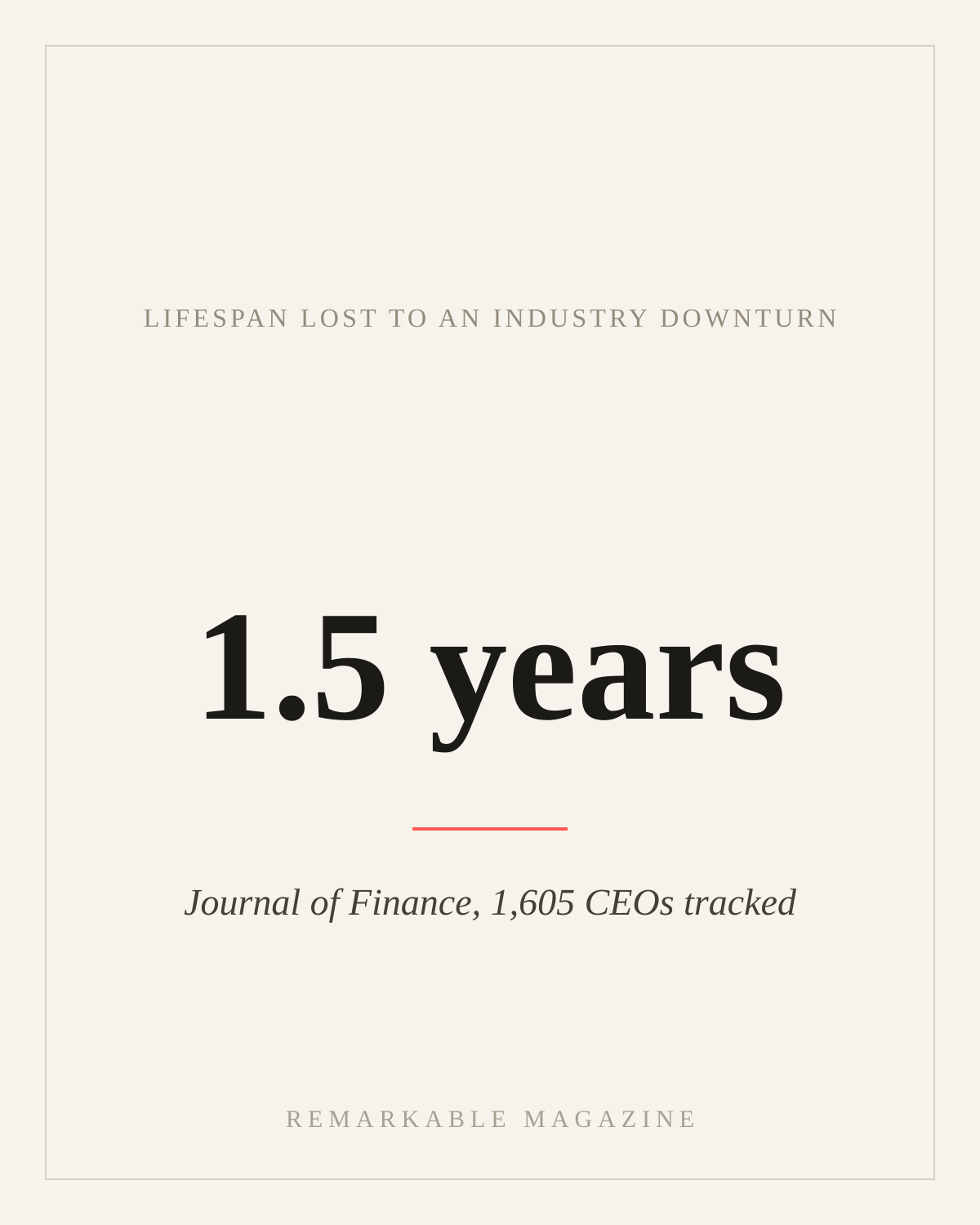
The result, as summarized in the paper’s own abstract: CEOs’ lifespan increased by about two years when insulated by anti-takeover laws, and decreased by about 1.5 years in response to an industry-wide downturn.
The faces confirm it
Mortality data alone can be a slow signal — a CEO who served in the 1980s might not show an effect for decades. So the researchers added a second, faster measurement: visible aging.
They applied neural-network machine-learning techniques, trained on a large image set, to estimate the apparent age of CEOs in more than 3,000 photographs spanning the early 2000s through 2018. Comparing each CEO’s estimated age against their actual age, before and after the 2007-2008 financial crisis, they found that CEOs whose industries took the hardest hit from the crisis looked roughly one year older than their less-exposed peers over the following decade.
Knowledge at Wharton, reporting on the study, summarized the throughline: when a CEO has higher job demands, they age faster — and, ultimately, die younger. UC Berkeley Haas’s own research newsroom put a number on the mechanism behind it, reporting that each year of less stringent governance (meaning less insulation, more exposure to market discipline) was associated with up to a 5% higher mortality rate in the sample.
Why this matters more for founders than for the CEOs it studied
Here’s the honest caveat: this isn’t a study of startup founders. It’s a study of chief executives running large, publicly traded companies — people who, by definition, have a board of directors, general counsel, an investor-relations function, and often a communications team standing between them and the sharpest edges of a crisis.
That’s what makes the finding sharper for the rest of this magazine’s audience, not softer. The entire effect the paper documents runs through insulation from stress, not its absence. Anti-takeover laws didn’t eliminate a CEO’s job pressure — they removed one specific source of acute threat, and that alone was worth two years of life. A downturn didn’t create stress from nothing — it removed one layer of control over outcomes, and that alone cost 1.5 years.
A solo founder or an early-stage startup CEO has none of the insulation this study’s subjects had to lose. There’s no general counsel filtering a lawsuit threat, no board spreading the responsibility for a bad quarter, no investor-relations team managing the narrative after a layoff. The mechanism the paper isolates — stress without a buffer — is closer to the founder’s default operating condition than the exception.
The biological mechanism isn’t exotic
None of this requires a novel biological theory. Chronic stress is a well-established, independent risk factor for cardiovascular disease, according to the American Heart Association, which in 2025 committed $15 million to further study exactly how it happens. The mechanism runs largely through cortisol and other stress hormones: sustained elevation promotes inflammation and contributes to the plaque buildup behind heart disease, and separate American Heart Association-funded research has linked depression, anxiety and stress directly to worse heart-health outcomes.
The CEO study gives that general mechanism a specific, measured price tag inside one well-defined population: stress exposure is worth roughly two years of life, in either direction, depending on how much of it an executive is insulated from.
What this doesn’t argue
It doesn’t argue that running a company is uniquely deadly, or that founders should quit. It also doesn’t contradict the site’s own reporting on founder burnout, which found that solo founders with no staff to manage actually carry the lowest burnout risk of any group studied — isolation, not workload, is the mechanism there. Nor does it suggest sleep is the fix; that’s a separate, distinct finding about judgment, not longevity.
What it adds is a different, more physical register to the same underlying point: the things that reduce a founder’s exposure to acute, uncontrolled stress — a co-founder to share the decision load, a clear handoff plan instead of an open-ended crisis, boundaries that actually hold — aren’t just good for avoiding a breakdown. On this evidence, they’re worth literal years.
Related reading
- Founder Burnout: What the Research Actually Shows — the psychological companion to this piece: why isolation, not entrepreneurship itself, is the documented risk factor for burnout.
- Founder Loneliness Is Real. Here’s What Actually Helps. — the specific mechanism named above as a buffer against acute stress.
- Do Founders Really Need Less Sleep? The Research Says No — a separate, distinct cost of founder stress: degraded judgment, not shortened lifespan.
The CEO lifespan and aging findings, the 1,605-CEO sample, the anti-takeover-law and industry-downturn natural experiments, and the 2007-2008 financial-crisis facial-aging analysis are per Mark Borgschulte, Marius Guenzel, Canyao Liu and Ulrike Malmendier, “CEO Stress, Aging, and Death,” NBER Working Paper 28550 (March 2021), published in the Journal of Finance (2025), as stated on the paper’s NBER abstract page (nber.org/papers/w28550). Sample details, the 3,000-plus photographs, and the “higher job demands age faster, die younger” framing are per Knowledge at Wharton’s report on the study. The governance-stringency mortality figure and additional context are per UC Berkeley Haas School of Business’s research newsroom. The chronic-stress-cardiovascular link, the $15 million research commitment, and the depression/anxiety/stress heart-health findings are per the American Heart Association.
Frequently asked
Does stress actually shorten a CEO's life, or just make the job feel harder?
Both, and the Journal of Finance paper by Mark Borgschulte, Marius Guenzel, Canyao Liu and Ulrike Malmendier measured the first one directly. Using hand-collected birth and death records for 1,605 CEOs of large, publicly listed U.S. firms, they found two natural experiments moved actual lifespan: CEOs insulated from hostile-takeover threats by anti-takeover laws lived about two years longer on average, and CEOs whose industry went through a downturn lived about 1.5 years less. This is mortality data, not a self-reported stress survey.
How did researchers measure CEO aging without waiting decades for outcomes?
They trained neural-network machine-learning software to estimate apparent age from more than 3,000 photographs of CEOs taken before, during and after the 2007-2008 financial crisis, then compared each CEO's estimated age against their actual age. CEOs whose industries were hit hardest by the crisis looked roughly one year older than their unexposed peers over the following decade — a visible, physical marker of the same stress effect the lifespan data captured.
Does this research apply to startup founders, or just Fortune 500 CEOs?
The study itself covers chief executives of large, publicly listed U.S. companies — people with boards, general counsel, and investor-relations staff absorbing part of the pressure. It doesn't directly measure solo or early-stage founders. But the mechanism it isolates is exposure to stress without insulation from consequences, and that is the condition most startup founders are in by default, without a board's anti-takeover provisions or a PR team standing between them and the bad news.