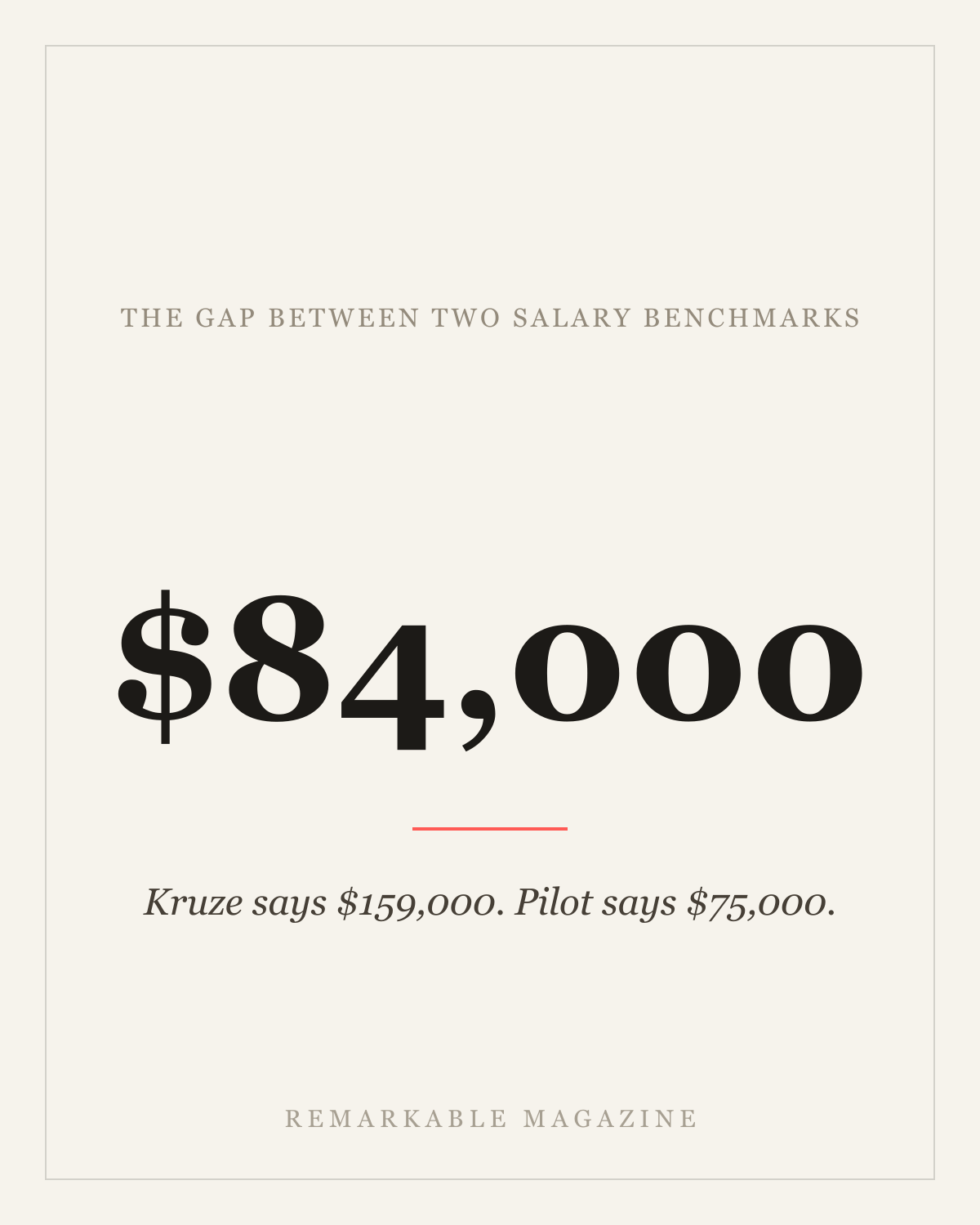
Ask how much a founder should pay themselves and you’ll get answers that look like they can’t both be true. One well-documented 2026 report puts the median at $159,000. Another, released the same year, puts it at $75,000. Neither number is wrong. They’re measuring different founders.
The number if you’ve raised money
Kruze Consulting, an accounting firm that works almost exclusively with venture-backed startups, publishes an annual CEO Compensation Benchmarks report built from actual payroll data across its book of more than 550 funded clients — not survey estimates, but what those companies are really running through payroll. The 2026 edition, released in April, put the average startup CEO salary at $165,000, up from $161,000 the year before, with a median of $159,000.
The number moves a lot by stage: roughly $90,000 for bootstrapped and pre-seed companies, $132,000 to $149,000 at seed, $175,000 to $203,000 at Series A, $214,000 to $235,000 at Series B, and up to $290,000 at Series C and later. AI startup founders — now 40% of Kruze’s client base — paid themselves a median of $90,000, lower than the broader median despite the AI funding boom, likely because so many of those companies are still early-stage.
Kruze VP Healy Jones has described the pattern behind the spread this way: “The interesting thing here is how the companies that have raised more capital (and who are confident that they can continue to access capital) are paying much higher CEO salaries. However, lightly funded startups — where the founders probably have more control over the pay than the VCs — are paying less as founders start to react to the more conservative funding environment. It’s becoming a tale of two cities.”
The number if you count everyone else
Pilot, a bookkeeping and CFO-services firm that works with a much broader mix of startups, runs its own annual Founder Salary Report. The most recent edition, based on 1,844 founder responses across funding stages and geographies, found a median founder salary of $75,000 — down 43% from $132,000 the year before, as reported by Inc.
The drop tracks a shift in who’s answering the survey, not just tighter belts at existing companies. Bootstrapped founders — who take home far less than their VC-backed peers on average — grew to 18% of Pilot’s respondents, up 77% year over year. Of the founders in the survey paying themselves between $100,000 and $200,000, 90% were VC-backed and only 10% were bootstrapped. Nearly twice as many founders paid themselves under $100,000 compared with the year before (60% versus 37%), and the median amount of funding those founders had raised fell from $4 million to $500,000. One data point cuts the other way, though: fewer founders are paying themselves nothing at all — 5.4%, down from 9% — suggesting that even as the numbers shrink, more founders are recognizing zero pay isn’t sustainable.
Why two real reports land $84,000 apart
Neither firm is wrong, and neither is padding its numbers. Kruze’s client base is, by definition, companies that already convinced investors to write checks — a population selected for having raised money, which pushes the whole distribution up. Pilot surveys founders more broadly, and its sample has been shifting toward bootstrapped and self-funded operators, who were never going to show up in Kruze’s book of clients in the first place. Ask “what do funded startup CEOs pay themselves” and the honest answer is close to $159,000. Ask “what do founders pay themselves” — funded and unfunded together — and the honest answer is closer to $75,000. They’re not describing the same founder.
What to actually do
- If you’ve raised a priced round, Kruze’s by-stage numbers are a reasonable starting point for a board conversation — investors are used to seeing those ranges, and coming in wildly outside them (in either direction) tends to draw questions.
- If you’re bootstrapped, a funded-startup comp benchmark isn’t the right target. Pilot’s data shows self-funded founders are already paying themselves well below market; the number that matters is what actually covers your expenses without forcing you back into full-time employment.
- Revisit it at every milestone, not once. Both reports show the same underlying truth from opposite directions: founder pay tracks capital raised and revenue much more tightly than it tracks title or hours worked.
- Zero isn’t a strategy. Pilot’s own data shows the share of founders paying themselves nothing has been falling, not rising — a signal that going unpaid indefinitely is becoming the exception even among the most cash-conscious founders, not a badge of commitment.
There’s no single correct number here, and both reports would say so. There is a correct question, and it’s not “what’s the market rate for a founder” — it’s “which market am I actually in.”
Related reading
- How to Split Equity Between Co-Founders — another case where two credible, experienced sources give opposite advice for good reasons.
- Founder Burnout: What the Research Actually Shows — on the risk of treating your own pay, and your own limits, as the last thing worth budgeting for.
- Pieter Levels Built a Flight Simulator. $1M ARR in 17 Days. — a solo, bootstrapped founder who set his own number with no board to answer to.
Frequently asked
Is the real median founder salary $159,000 or $75,000?
Both, depending on who's being measured. Kruze Consulting's 2026 CEO Compensation Benchmarks pull from real payroll data across its client base of 550+ VC-backed startups and put the median CEO salary at $159,000 — a population that, by definition, already raised outside capital. Pilot's Founder Salary Report surveys founders more broadly, including a fast-growing share who are bootstrapped and self-funded, and found a median of $75,000. The gap isn't a data error; it's two different populations answering two different questions.
How should a founder actually decide what to pay themselves?
If you've raised a priced round, Kruze's by-stage benchmarks (roughly $90,000 pre-seed rising to $290,000 at Series C+) are a reasonable anchor for a board conversation, since investors are used to seeing those ranges. If you're bootstrapped, market comps matter less than your own survival number — what covers your actual expenses without forcing you back into a day job — because Pilot's data shows self-funded founders are already paying themselves well below market on average. Either way, treat the number as something to revisit at each funding or revenue milestone, not something you set once and forget.