Paul Graham’s 2006 essay “The 18 Mistakes That Kill Startups” put single founders at the top of the list, and made the case in one line: “Have you ever noticed how few successful startups were founded by just one person? … It seems unlikely this is a coincidence.” Going it alone, in his framing, was itself evidence something was wrong — a founder who couldn’t talk anyone else into joining.
Twenty years later, the volume of solo founders has moved in exactly the opposite direction from what that warning predicted.
Solo founding just hit an all-time high
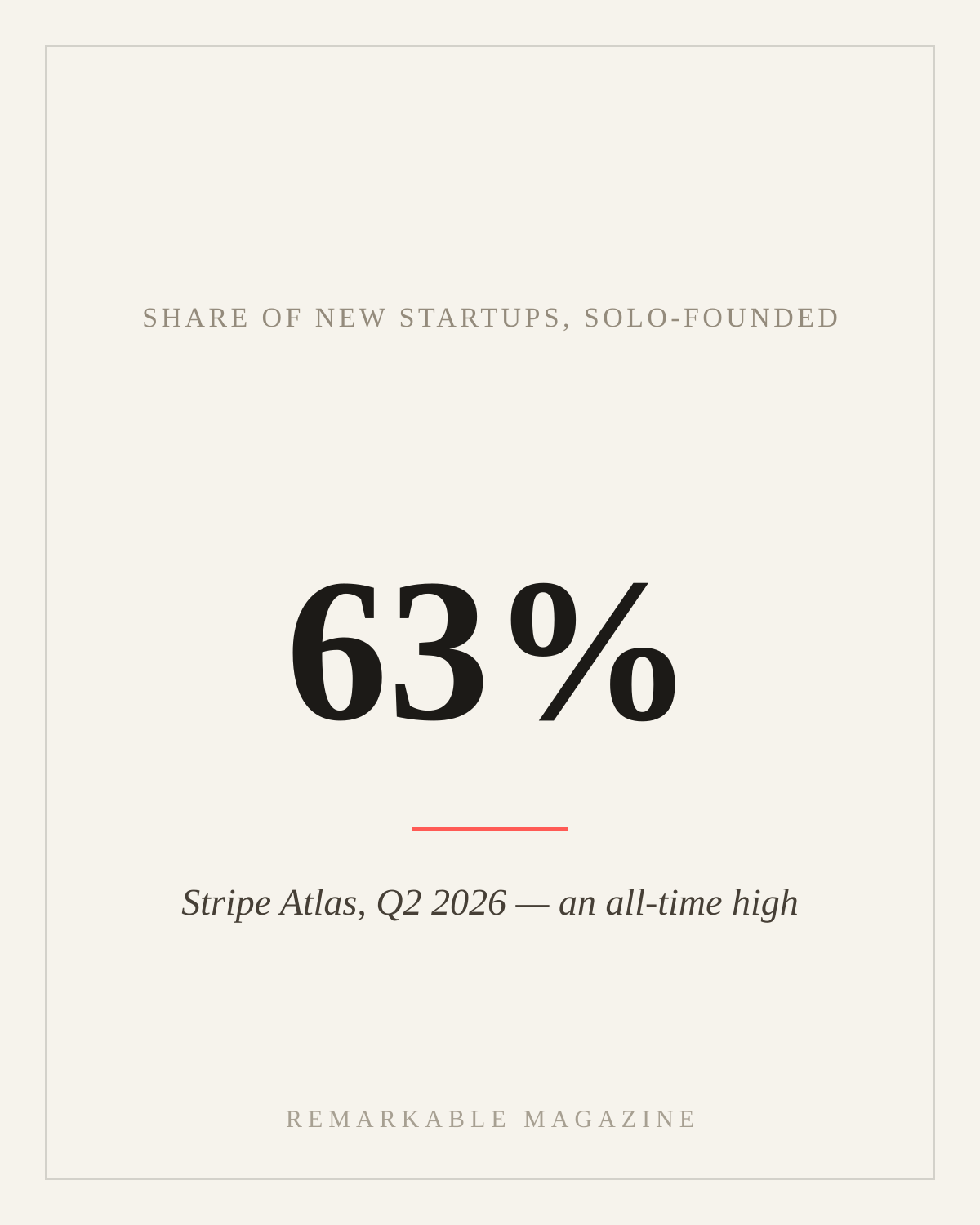
Stripe reported in May 2026 that solo founders accounted for 63% of C corporations formed through Stripe Atlas in Q2 2026 — the highest share the platform has recorded. That’s not a blip. Carta’s Solo Founders Report 2025 shows the same climb from a different data set: the share of new startups on Carta with a single founder rose from 23.7% in 2019 to 36.3% in the first half of 2025, up from 31% in just the prior year.
Both platforms point at the same driver: AI tooling has expanded what one person can actually ship. Stripe’s report found the performance gap between solo founders widening, not narrowing, as that tooling matures. Top-decile solo founders earned about 61 times the revenue of the median solo founder in their first six months in 2025 — up from a 34x gap just four years earlier. At the same time, the median solo founder’s initial six-month revenue was down 23% year over year. More people are founding alone; the ones who make it work are pulling further ahead, and the typical outcome is getting worse, not better.
The funding market hasn’t caught up
Founding solo and getting funded solo turn out to be two different problems. Carta’s data shows a real gap between how many startups are solo-founded and how much capital reaches them: solo founders were roughly 30% of startups founded in 2024, but companies that closed a venture round that same year were only about 17% solo-founded — and solo-led companies captured just 14.7% of the total cash raised across priced equity rounds. Among startups that do close funding, two-person founding teams remain the most common configuration on Carta’s platform, a rate that climbs even higher in SaaS specifically.
Read plainly: investors still price in Graham’s 2006 instinct even as the founder population moves away from it. A solo founder building a product that outgrows what one person can run into isn’t unusual anymore — getting a venture firm to write the check for it still is.
What actually predicts whether solo works
A 2026 study in the Strategic Management Journal by Travis Howell, an Arizona State University management professor, and coauthor Todd Hall, gives the clearest answer yet to when Graham’s warning holds and when it doesn’t. Using data from Y Combinator’s accelerator program alongside a larger Crunchbase data set, the study found solo founders are, on average, at a genuine disadvantage against founding teams — consistent with the conventional wisdom Graham articulated. But that disadvantage isn’t fixed. It’s substantially attenuated for founders who bring either broad experience across multiple functions or deep experience in one — “T-shaped” backgrounds that let a single person credibly cover ground a co-founder would otherwise fill.
That’s a materially different claim than “solo founders can’t win.” It says the deciding variable isn’t whether you’re alone — it’s whether you’ve already accumulated, on your own, the range or depth a second founder would otherwise supply.
What the top solo founders say changed
Stripe’s report put that shift in the words of the founders living it. Among those it interviewed was Marc Lou — fired from a marketing job in 2021, now running a one-person portfolio of software products that cleared $1,032,000 in 2025, previously profiled by Remarkable Magazine. Lou told Stripe: “The next generation of solo founders will be less defined by technical pedigree and more by speed. They’ll be no-code people focused on solving a problem, shipping crazy fast with AI, and cracking distribution on social media.”
That’s close to a direct rebuttal of Graham’s original mechanism. Graham’s essay assumed a single founder was short-handed on the same tasks a team would split. Lou’s read is that AI tooling collapsed enough of that workload that speed, not headcount, decides the outcome — a claim that shows up in Remarkable’s own reporting, too: Maor Shlomo built Base44 alone, took it to $1M ARR within three weeks of launch, and sold it to Wix for $80 million about four months after launch, without ever bringing on a co-founder.
So which is it?
The data doesn’t resolve into a single answer, because it isn’t measuring a single question:
- If the question is “can one person build something real,” the answer has clearly shifted toward yes. Stripe’s 63% figure and Carta’s rising solo share both track a population, not a fluke — and the top decile of that population is outperforming further every year.
- If the question is “will a solo founder get funded the same as a team,” the answer is still mostly no. Carta’s 14.7%-of-capital figure shows investors have not moved nearly as far as the founder population has.
- If the question is “should I found alone,” Howell and Hall’s finding is the most useful individual answer available: it depends on whether you already have the breadth or depth a co-founder would otherwise bring, not on some fixed penalty for being one person.
There’s a fourth angle worth weighing alongside all of this, from Remarkable’s own reporting on founder burnout: a 2022 University of Amsterdam study found solo founders with no staff had the lowest burnout risk of any group studied, with risk climbing specifically once a founder hires and starts managing people. Founding alone isn’t free — the funding gap is real — but on the data available right now, it isn’t the red flag Graham described in 2006 either.
Related reading
- Marc Lou Was Fired in 2021. He Now Runs 15+ Startups Alone and Cleared $1M in a Year.
- Six Months, $80 Million: How Maor Shlomo Built Base44 Alone
- Founder Burnout: What the Research Actually Shows
- How to Split Equity Between Co-Founders — the question that only comes up once you decide not to go it alone.
Frequently asked
Are more startups being founded solo now than in past years?
Yes, on two independent data sets. Stripe reported in May 2026 that solo founders accounted for 63% of C corporations formed through Stripe Atlas in Q2 2026, an all-time high for the platform. Separately, Carta's Solo Founders Report 2025 found the share of new startups on Carta with a single founder rose from 23.7% in 2019 to 36.3% in the first half of 2025 — a trend Carta ties partly to AI tools letting one person do work that used to require a team.
Do solo founders have a harder time raising venture capital?
Considerably harder, according to Carta's data. Solo founders made up roughly 30% of startups founded in 2024, but companies that closed a venture round before the end of that year were only about 17% solo-founded, and solo-led companies captured just 14.7% of the total cash raised in priced equity rounds. Two-founder teams remain the most common configuration among startups that actually close funding rounds.
Does research back up Paul Graham's warning against founding alone?
It's more conditional than his original 2006 essay suggested. A 2026 Strategic Management Journal study by Travis Howell (Arizona State University) and Todd Hall, using data from Y Combinator's accelerator and Crunchbase, found that solo founders are at a real disadvantage on average — but that disadvantage shrinks substantially for founders with either broad experience across functions or deep experience in one, so-called 'T-shaped' backgrounds. The disadvantage isn't fixed; it depends on who is founding alone.