Supplements are a category where trust is the product. On October 22, 2026, Paine Schwartz Partners, a private equity firm that describes itself as the largest dedicated to sustainable food chain investing, announced a strategic investment in First Day, the Austin vitamin brand built by Alice Li. She stays in charge.
At a glance
| Brand | First Day (legal name First Day Life, Inc.), Austin, Texas |
| Founded | 2019, by Alice Li |
| Investor | Paine Schwartz Partners, via Paine Schwartz Food Chain Fund VI; about $6.5 billion in assets under management, per its release |
| Price, stake, valuation | Not disclosed |
| Who stays | Alice Li as Founder and CEO, “with support from the Paine Schwartz team” |
| Advisers | Perella Weinberg Partners and Greenberg Glusker for First Day; Morrison & Foerster for Paine Schwartz |
| Announced | October 22, 2026 |
What the company says it is
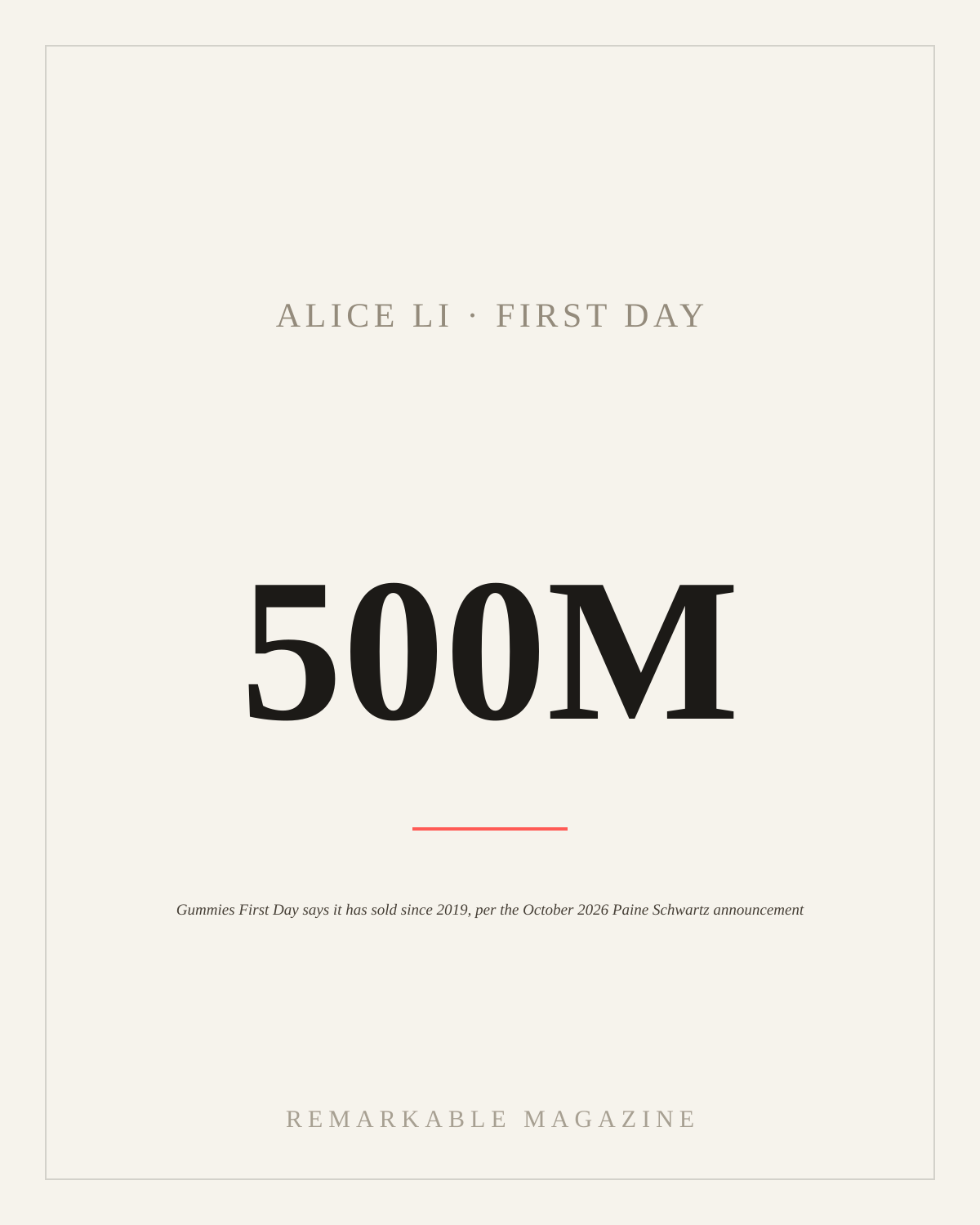
According to the release, First Day makes “science-informed, clean-label” vitamins, minerals and supplements for the whole family: a multivitamin, magnesium, tribiotic and brain-support formulas. It sells direct to consumers, on Amazon and in retail. Its “No Junk” commitment means no artificial sugars, dyes or fillers. The company says it has sold more than half a billion gummies since 2019 and is trusted by more than one million families. PE Professional repeats those figures. They are the company’s own numbers, relayed in a press release, and none of the outlets we opened verified them independently.
In the release, Li says: “Our mission is to help families live healthier lives,” and “We’re making clinical science approachable through products that deliver meaningful results.”
A founder who started with her grandparents
In a Shopify profile, Li traces the idea to her family. A Chinese American, she saw how her grandparents’ lack of nutrition during the Great Chinese Famine of the 1950s affected their health as they aged, and wanted to spare other families something similar. Because she describes the supplement industry as one with a poor reputation, Shopify reports, she spent the early days reading scientific papers and talking with professors and medical professionals, some of whom later became advisers.
The commercial choices followed. Shopify reports that she aimed her marketing at mothers, who she says buy for several members of a household, and set targets for customer acquisition cost and run rate so the economics held up from the start. Shopify also reports that First Day reached profitability a month ahead of a six-month goal. That is a single-source account of the company’s own history, so read it as Li’s telling, not an audited fact.
Why Paine Schwartz
Kevin Schwartz, the firm’s CEO, said in the release that First Day “is directly aligned with our core thesis of investing in health and wellness companies,” and that Li “has built a brand that stands apart.” The release says the deal builds on the firm’s consumer and better-for-you investments, naming Promix, Suja Life and BetterCo Holdings. Li’s stated goal is an omnichannel family health brand, meaning the same product across DTC, Amazon and store shelves.
What we do not know
- The price, the valuation and the stake. None of the release, Morrison & Foerster’s note or PE Professional gives them, and none says whether the position is majority or minority.
- Revenue. The sources we opened give gummies sold and families served, not sales. Other sites circulate revenue figures; we did not find one from a source we could verify, so we do not print one.
- Earlier investors. Third-party databases disagree about whether First Day had raised outside money before, so we do not characterise it.
- What changes for customers. Nothing in the announcement describes product, pricing or sourcing changes.
What founders can take from it
- In a distrusted category, the evidence is the brand. Li’s account is that she started by reading the research and recruiting clinicians as advisers, before she marketed anything.
- Pick one buyer and know her. The mother who buys for the whole household is the customer First Day says it designed around, per Shopify.
- “Strategic investment” is not a sale. The announcement keeps the founder as CEO and does not say she sold control, so read the terms before calling it an exit.
Related founders
- Pete Maldonado and Chomps: another founder-led brand taking a private-equity partner.
- Kenneth and Jean Baik and Miss A: a first outside investment for a founder-run brand.
- Founder Exits of 2026: the year’s deals in one table.
Sourcing: deal facts, advisers and quotes are from the Paine Schwartz announcement issued through PR Newswire (read via a Webull reproduction), the Morrison & Foerster note of October 23, 2026, and PE Professional of October 26, 2026, all opened November 26, 2026. The founding story and Li’s account of profitability are from a Shopify profile, a single source. Gummies and families served are company figures. No portrait is used; the image is a typographic card.
Frequently asked
Who invested in First Day?
Paine Schwartz Partners, through its Paine Schwartz Food Chain Fund VI, announced a strategic investment in First Day Life, Inc. on October 22, 2026. Terms were not disclosed, per the PR Newswire release, Morrison & Foerster and PE Professional.
Is Alice Li still CEO of First Day?
Yes. The announcement says Li, who started First Day in 2019, remains Founder and CEO, with support from the Paine Schwartz team.
How much did Paine Schwartz pay for First Day?
Not disclosed. The announcement does not give an amount, a valuation or the size of the stake, and the sources we opened do not say whether it is a majority or minority position.
What does First Day sell?
Clean-label vitamins, minerals and supplements for the whole family, including multivitamin, magnesium, tribiotic and brain-support formulas, sold direct to consumers, on Amazon and in retail, per the announcement.