Amjad Masad spent fifteen years trying to make programming easier to learn. Then, in 2024, he built something that made learning it optional — and told his own community he was doing it on purpose.
Nine years of not much
Masad grew up in Amman, Jordan, where he learned to code in the 1990s, frustrated even then, as he later told the newsletter Platformer, by “all this annoying stuff that should be automated.” He worked as a founding engineer at Codecademy from 2011 to 2013, then at Facebook on JavaScript infrastructure until 2016, before co-founding Replit that year with his wife, Haya Odeh, and his brother, Faris Masad — a browser-based environment where writing and running code took nothing more than an open tab.
For years, that’s what Replit was: a genuinely useful tool for professional developers and students, growing the way developer tools usually do. TechCrunch later reported that Replit’s annualized revenue had sat around $2.8 million for years — essentially flat, on a business Masad had built his career around.
The decision that reversed his own mission
On September 5, 2024, Masad announced Replit Agent on X. “AI is incredible at writing code,” he wrote. “But that’s not enough to create software. You need to set up a dev environment, install packages, configure DB, and, if lucky, deploy. It’s time to automate all this.” On its face, it read like a feature launch — automating the tedious plumbing around code that a human had already written.
The harder part, Masad told Platformer’s Casey Newton, was what it meant underneath. Replit’s whole premise, and a good chunk of Masad’s own identity, had been about lowering the bar to learning to code. Agent lowered the bar so far there was no bar — a user could describe what they wanted and never look at the code at all. “My entire life mission around teaching people coding is changing… I need to be honest with myself,” he told Newton. He called the reaction from programmers online “hugely controversial,” with pushback landing on Twitter and Hacker News from people who’d built their own careers, and often their own identities, around the craft Masad now considered optional.
What happened once it shipped
The business case answered itself faster than the identity question did. TechCrunch reported Replit’s annualized revenue climbing to $100 million by June 2025, then $150 million by September 2025 — more than 50 times what it had been a year earlier. That September, Replit raised $250 million at a $3 billion valuation, led by Prysm Capital with participation from Amex Ventures and Google’s AI Futures Fund, up from a $1.16 billion valuation on its prior round in 2023.
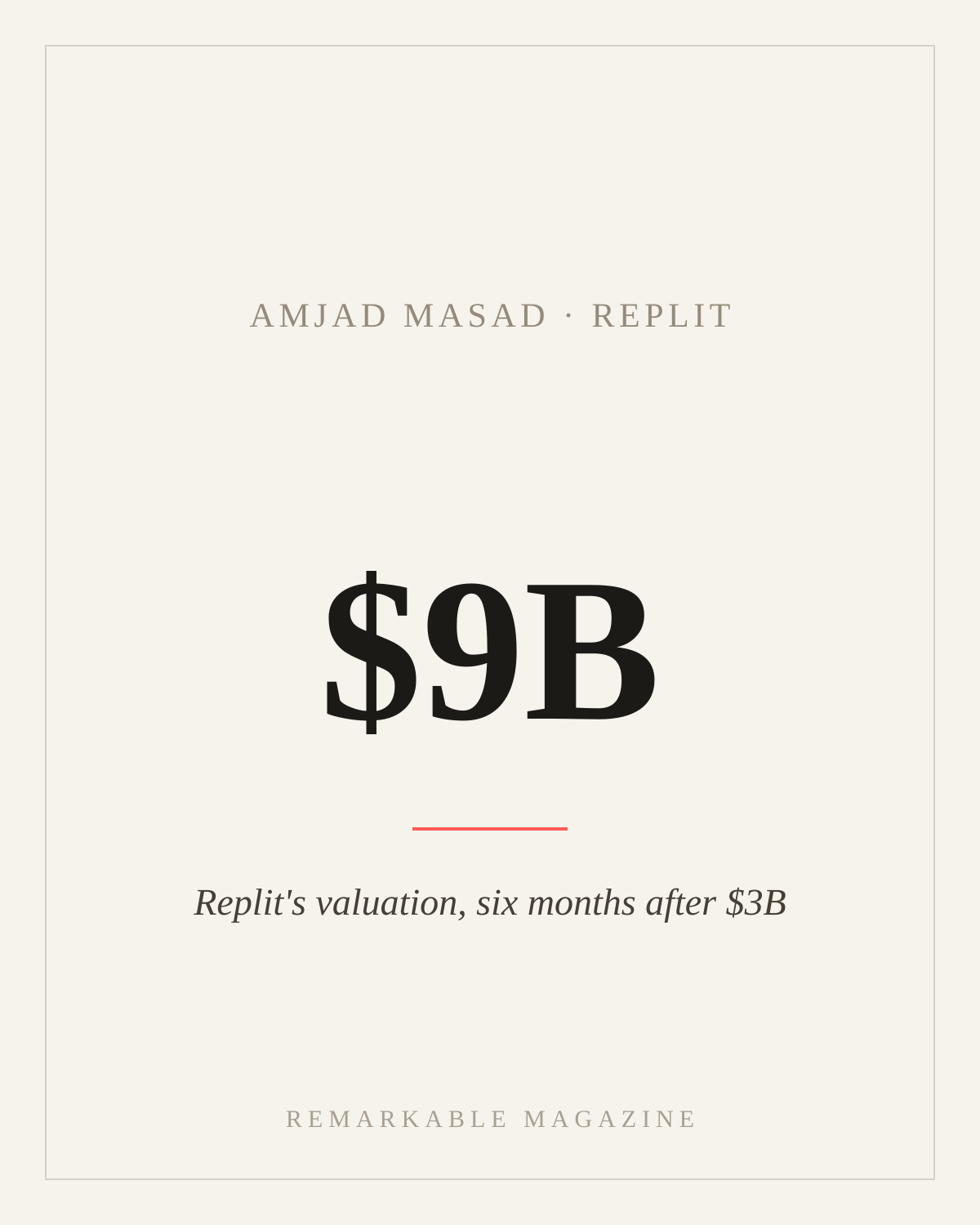
Six months after that, on March 11, 2026, Replit confirmed a $400 million Series D at a $9 billion valuation — tripling again — led by Georgian, with G Squared, Prysm Capital, Coatue, Andreessen Horowitz, Craft Ventures and Y Combinator returning, plus strategic backing from Accenture Ventures, Databricks Ventures, Okta Ventures and Qatar Investment Authority, and angel investors including Shaquille O’Neal and Jared Leto. Alongside the raise, Replit shipped Agent 4, built around what Replit called a “digital canvas” where users sketch and iterate on an app’s design with the agent in real time rather than only typing prompts at it. “It’s about designing together with the agent,” Masad said, comparing it to how “designers working with engineers, they’re on the whiteboard, they’re drawing.” Replit put its user base at more than 50 million, with customers including Zillow, Databricks, PayPal and Adobe, and said it was targeting $1 billion in annual recurring revenue by the end of 2026. Forbes estimated Masad’s stake in the company was worth about $2 billion after the round.
The part he still won’t apologize for
Masad has been direct about staying narrow rather than chasing the AI labs he now competes with for attention. “We can’t cure cancer,” he said of Replit, describing the company’s edge as focus rather than scale. “Replit is about making everyone a software engineer… I just know our limits.” Asked how the company got through the stretch when the old business was flat and the new bet hadn’t paid off yet, his answer was less about strategy than temperament: “I’m willing to throw away code, throw away work, and restart from scratch. I don’t get sentimental.”
That’s the harder version of the founder-pivot story. It’s not just that Masad bet the company on a product professional developers might resent. It’s that the product worked against the thing he’d spent a career teaching people to value — and he shipped it anyway, in public, and let the number decide who was right.
Related founders
- Michael Truell Built Cursor. SpaceX Paid $60 Billion For It. — another AI coding company that found its business only after abandoning its first idea.
- How Eric Simons Built Bolt.new to a $700M Valuation — a coding tool weeks from shutting down before an AI-agent pivot turned it around.
- Six Months, $80 Million: How Maor Shlomo Built Base44 Alone — the same “describe it, don’t code it” bet, built and sold by one person.
Amjad Masad’s biography — his childhood in Amman, Jordan, his roles at Codecademy (2011–2013) and Facebook (2013–2016), and Replit’s 2016 founding with Haya Odeh and Faris Masad — is per Wikipedia’s sourced entry and TechCrunch’s reporting on the company. The $2.8 million pre-pivot annualized revenue, the climb to $100 million ARR by June 2025 and $150 million by September 2025, the September 2025 $250 million raise at a $3 billion valuation (up from $1.16 billion in 2023), and the March 11, 2026 $400 million Series D at a $9 billion valuation are per TechCrunch’s reporting (techcrunch.com, September 10, 2025 and March 11, 2026), corroborated on the funding round by Replit’s own announcement (replit.com/news/funding-announcement) and Dealroom’s coverage. The September 5, 2024 Replit Agent announcement and its exact wording are from Amjad Masad’s own post on X. The “hugely controversial” reaction and Masad’s “my entire life mission” quote are from his interview with Casey Newton at Platformer. The “It’s about designing together with the agent,” “We can’t cure cancer,” and “I’m willing to throw away code” quotes, the Agent 4 product description, the 50 million-plus user figure, the Zillow/Databricks/PayPal/Adobe customer list, and the $1 billion ARR target are per Replit’s own account of the funding round. Forbes’ estimate of Masad’s roughly $2 billion net worth following the round is as cited by Forbes and reflected in Wikipedia’s sourced entry; Forbes’ own article could not be fetched directly for this piece (its site blocks automated retrieval), so that figure is relayed as Forbes’ reported estimate rather than independently verified here.