Four separate research teams, using four different methods in three different countries, keep landing on the same basic fact: people who start companies are far more likely to have ADHD than people who don’t. What none of them found is a clean story about whether that’s good news.
The prevalence numbers, from two directions
The Business Development Bank of Canada — a Crown corporation that lends to and surveys small businesses — published its 2025 Survey on the Mental Health of Canadian Entrepreneurs in November 2025. Among 1,463 entrepreneurs, 7% had received a professional ADHD diagnosis, and another 24.8% reported ADHD-related symptoms without one. The rate wasn’t evenly spread: 44% of entrepreneurs under 45 reported ADHD symptoms, against 13% of those over 45.
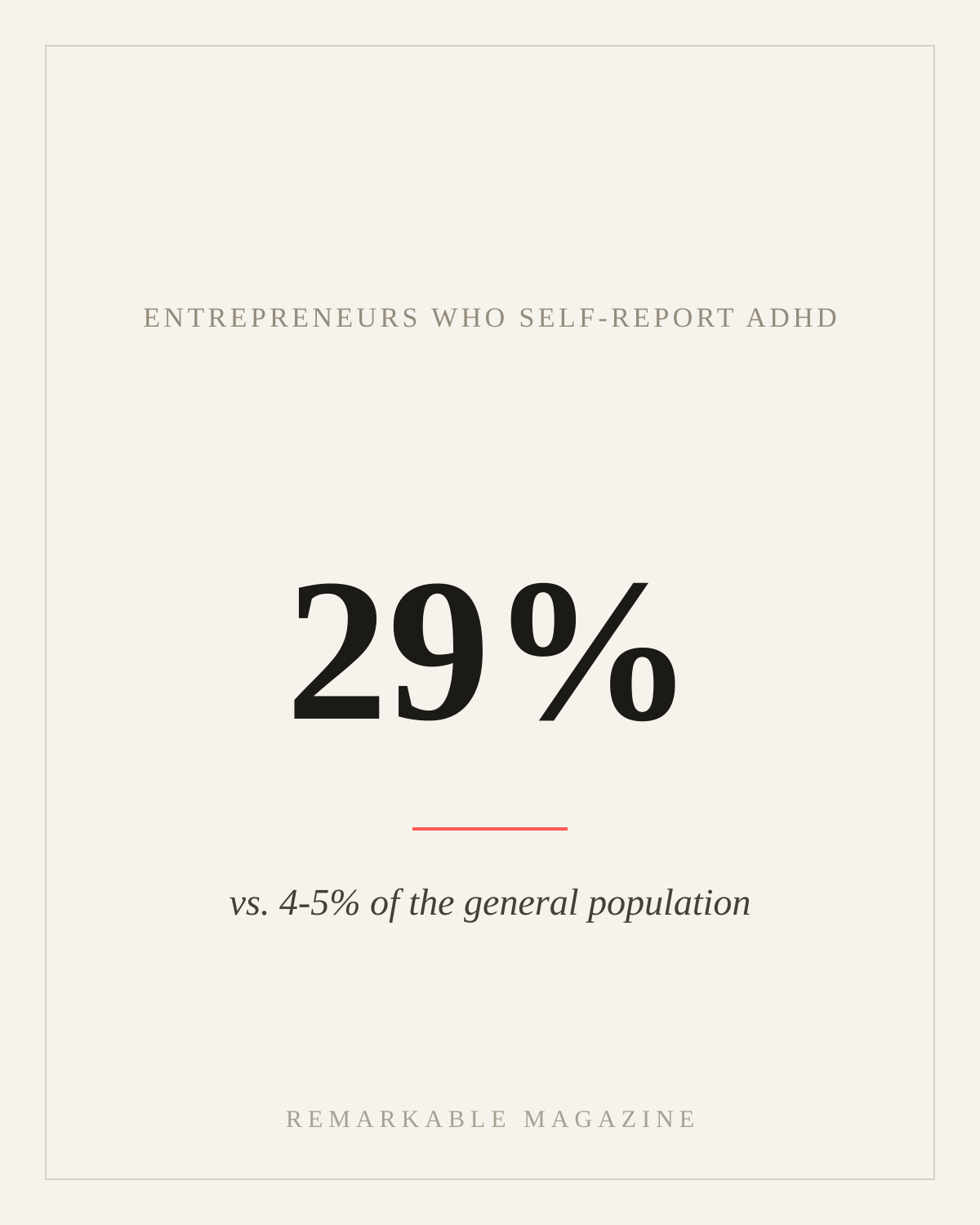
That tracks with an earlier, and now widely cited, U.S. study. Michael Freeman, a psychiatrist affiliated with UC Berkeley and UC San Francisco, surveyed 242 entrepreneurs against 93 demographically matched comparison participants and found 29% of the entrepreneurs self-reported a lifetime ADHD diagnosis, against 4-5% of the general population — alongside elevated rates of depression (30%), substance use conditions (12%) and bipolar disorder (11%). The work, first circulated in 2015 under the title “Are Entrepreneurs Touched with Fire?”, was peer-reviewed and published in Small Business Economics in 2019.
Different country, different decade, different survey instrument. Both land on ADHD showing up in founders at somewhere between four and six times the rate you’d expect from the general population.
What a 2025 meta-analysis found underneath that number
Prevalence alone doesn’t say whether ADHD helps or hurts. A 2025 meta-analysis in Entrepreneurship Theory and Practice, by Mi Hoang Tran (Rensselaer Polytechnic Institute), Johan Wiklund and Kevin Antshel (both Syracuse University), and Nandini Jhawar and Catherine Montgomery (Nemours Children’s Health), pooled 298 effect sizes across 47 empirical studies to answer exactly that.
It split ADHD into its two core symptom clusters and tracked each one separately across two different windows: getting a company started, and what happens to it afterward.
- Hyperactivity/impulsivity was positively associated with entrepreneurial intentions and behaviors — but showed no significant relationship to post-launch outcomes.
- Inattention showed no significant link to starting a company at all — but was negatively associated with outcomes after launch.
- Overall ADHD (combining total symptoms and clinical diagnosis) came out positively related to entrepreneurial behavior and negatively related to entrepreneurial outcomes, in the same population.
The traits that get someone into a business and the traits that determine whether it survives are not the same traits, and the meta-analysis found them cutting in opposite directions inside the same diagnosis.
The same split shows up in a real cohort, not just a model
That pattern isn’t just a statistical artifact of pooling many small studies. A 2021 Journal of Business Venturing paper by Nikhil Rajah, Vassiliki Bamiatzi and Nick Williams tracked a cohort of UK individuals from childhood, using teacher-identified ADHD-like symptoms recorded at age 10, then followed who went on to become business owners by ages 30 and 42. Childhood ADHD-like symptoms predicted selection into entrepreneurship — but among those who became entrepreneurs, the same symptoms were associated with lower earnings and shorter business survival than salaried alternatives.
Selected in by the same traits that later work against you: that’s the finding twice over, once from a meta-analysis of hundreds of effect sizes and once from a single longitudinal cohort followed for decades.
Wiklund’s own explanation for the split
Wiklund has studied this from the inside; his research program began after his own ADHD diagnosis. In earlier qualitative work, based on case studies of entrepreneurs previously diagnosed with ADHD, he identified impulsivity as a major driver of entrepreneurial action and hyperfocus as a major catalyst for what follows — for better and worse.
Asked by Esbri, the Swedish Entrepreneurship Forum’s publication, whether ADHD is a “superpower” for entrepreneurs, Wiklund’s answer wasn’t a clean yes: “As a researcher, I’d like to say: it depends.” His explanation lines up with what the meta-analysis measured. “In the early stages of entrepreneurship, traits often associated with ADHD — such as speed, drive, and creativity — can be strengths,” he said. “But that doesn’t mean ADHD always acts as a superpower. As the company grows and requires perseverance, structure, administration, and a long-term focus, what was once a strength can instead become a weakness.”
He also pushed back on treating ADHD as a personality type rather than a diagnosis: “A common misconception is to reduce ADHD to a few specific personality traits, such as having trouble sitting still, getting bored easily, or losing focus. But ADHD is more than that. It’s a psychiatric diagnosis that can lead to difficulties in many areas of life.”
What this doesn’t argue
It doesn’t argue that ADHD is a competitive advantage, and none of the researchers behind this work say that either. It doesn’t argue that relating to a few founder-coded traits — chaos, hyperfocus on the fun part, boredom with the boring part — means having ADHD; that requires a clinical evaluation, not self-recognition. And it doesn’t argue that a diagnosis dooms a company: the meta-analysis found no significant link between hyperactivity/impulsivity and outcomes, not a negative one. The negative signal was specific to inattention, and specific to the period after launch.
What the research actually supports is narrower and more useful: the same traits that make someone likely to start a company are not automatically the traits that make a company survive, and for founders who know or suspect they have ADHD, the stage-dependent shape of that finding — an asset early, a liability without support later — is the part worth planning around, not the prevalence number by itself.
Related reading
- Founder Burnout: What the Research Actually Shows — a related look at which founder traits and conditions actually predict poor outcomes, and which are red herrings.
- CEO Stress Doesn’t Just Burn You Out. It Ages You. — a harder, physical version of the same “unbuffered founder” problem this piece’s post-launch findings point toward.
- Do Founders Really Need Less Sleep? The Research Says No — another case where a trait that sounds like a founder advantage doesn’t hold up once it’s measured directly.
Prevalence and demographic figures are per the Business Development Bank of Canada’s 2025 Survey on the Mental Health of Canadian Entrepreneurs (published November 2025, 1,463 respondents), as stated on bdc.ca. The 29%-versus-4-5% comparison and the 242-versus-93 sample are per Michael Freeman et al., “Are Entrepreneurs Touched with Fire?,” peer-reviewed and published in Small Business Economics (2019). The 47-study, 298-effect-size meta-analysis and its hyperactivity/impulsivity-versus-inattention findings are per Mi Hoang Tran, Johan Wiklund, Kevin Antshel, Nandini Jhawar and Catherine Montgomery, “Entrepreneurship and ADHD: A Meta-Analytical Assessment of the State-of-the-Art and Suggestions for the Future,” Entrepreneurship Theory and Practice (2025, in press), as reported by Syracuse University’s Whitman School of Management newsroom. The childhood-cohort earnings and business-survival findings are per Nikhil Rajah, Vassiliki Bamiatzi and Nick Williams, “How Childhood ADHD-Like Symptoms Predict Selection into Entrepreneurship and Implications on Entrepreneurial Performance,” Journal of Business Venturing (2021), as summarized by the Entrepreneur & Innovation Exchange. The direct quotes from Johan Wiklund are per his interview with Esbri, the Swedish Entrepreneurship Forum.
Frequently asked
Are entrepreneurs actually more likely to have ADHD than other people?
Yes, across multiple independent studies. A 2025 Business Development Bank of Canada survey of 1,463 entrepreneurs found 7% had a professional ADHD diagnosis and 24.8% reported ADHD-related symptoms. An earlier UC Berkeley/UCSF study led by Michael Freeman, published in Small Business Economics in 2019, found 29% of 242 surveyed entrepreneurs self-reported a lifetime ADHD diagnosis, compared with 4-5% of the general population. These are two different surveys, in two different countries, using two different methods, landing on the same basic pattern: ADHD is markedly overrepresented among people who start companies.
Is ADHD an advantage or a disadvantage for founders?
Both, depending on the stage of the company, according to a 2025 meta-analysis of 47 studies and 298 effect sizes in Entrepreneurship Theory and Practice by Mi Hoang Tran, Johan Wiklund and colleagues. Hyperactivity and impulsivity were positively linked to starting a company but showed no significant relationship to how it performed afterward. Inattention showed no link to starting a company but was negatively linked to post-launch outcomes. A separate 2021 Journal of Business Venturing study found the same shape: childhood ADHD-like symptoms predicted who became an entrepreneur, but were associated with lower earnings and shorter business survival once they had. Johan Wiklund, the Syracuse University professor whose own ADHD diagnosis prompted this research area, has said the traits that help in the early stages — speed, drive, creativity — can become a liability once a company needs perseverance, structure and administration.
Does relating to ADHD traits mean I actually have ADHD?
No, and the same researchers studying this are explicit about it. Johan Wiklund has warned against reducing ADHD to a handful of relatable traits like getting bored easily or having trouble sitting still, calling that a common misconception. ADHD is a clinical psychiatric diagnosis, not a personality type, and the studies cited here measure either professional diagnoses or standardized symptom scales, not a reader's sense of self-recognition. If founder life feels chaotic, that's common founder experience; a diagnosis takes a clinician, not a content card.