Founders negotiate valuation for weeks. The clause that decides who is actually paid when the company is sold often gets a single line in the term sheet: “1x non-participating.” It’s the dull part of the deal, right up until an exit comes in below the number everyone was hoping for.
What the clause does
A liquidation preference is a payout order. When a company is sold or wound up, holders of preferred stock, typically the venture investors, are paid before holders of common stock, typically founders and employees. The National Venture Capital Association’s model certificate of incorporation, the template many US venture financings start from, puts it plainly: preferred holders are paid “before any payment shall be made to the holders of Common Stock by reason of their ownership thereof.” The model’s October 2025 update applies this to a dissolution and to a “Deemed Liquidation Event,” the charter’s term for a sale of the company, so the preference bites on an ordinary acquisition, not only on a shutdown.
Two dials control how much it matters: the multiple (how many times the original investment comes back first) and participation (whether the investor also shares in what’s left).
Non-participating: the standard
The NVCA’s non-participating form pays each preferred share “an amount per share … equal to the greater of (i) [__ times] the applicable Original Issue Price, plus any dividends declared but unpaid thereon, or (ii) such amount per share as would have been payable had all shares of such series … been converted into Common Stock.” The investor picks the better of the two. Never both.
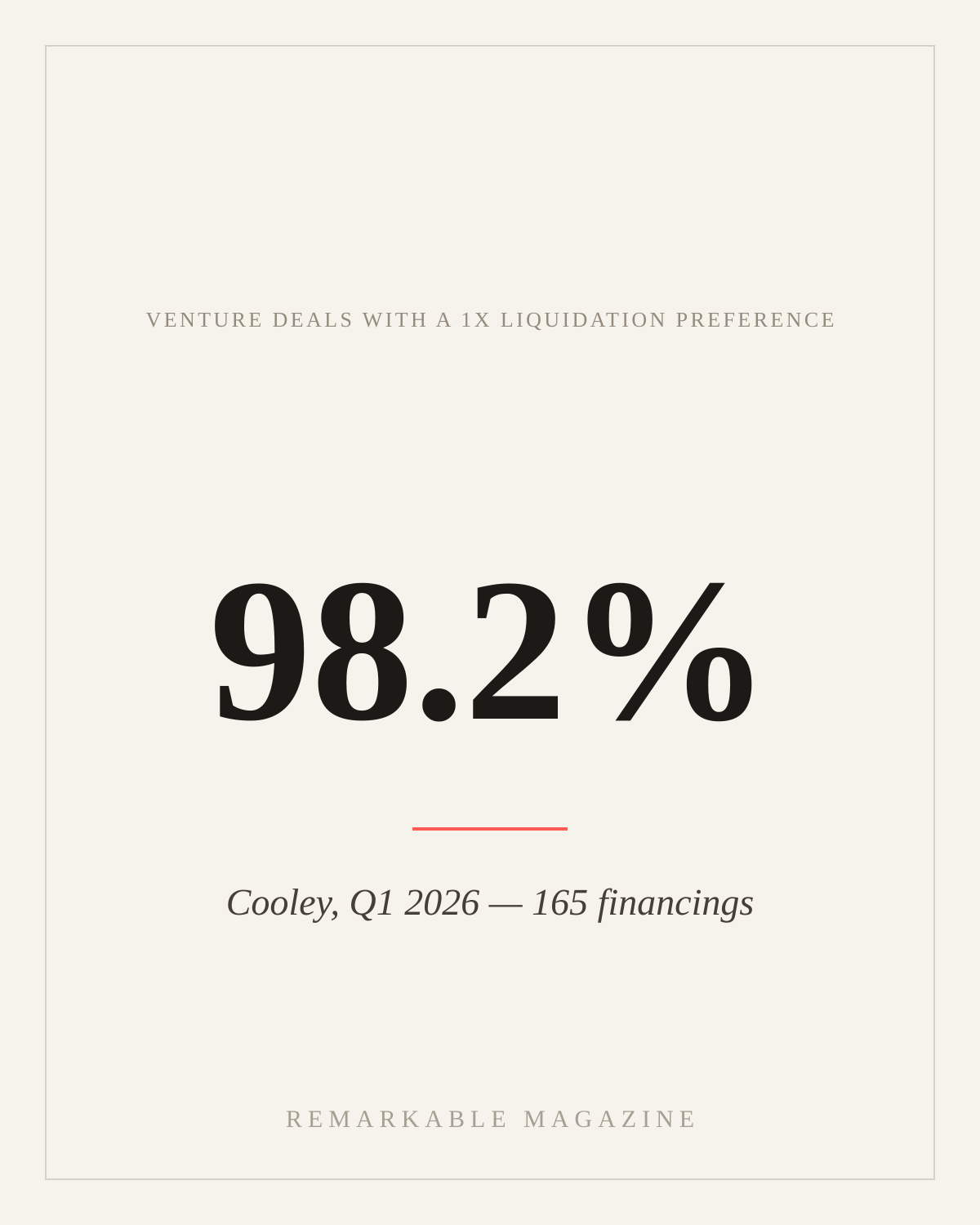
That is the overwhelming market norm. In its Q1 2026 Venture Financing Report (April 29, 2026), Cooley reported that of the 165 venture financings it handled that quarter, “98.2% of deals” had a 1x liquidation preference and “96.4% of deals” had nonparticipating preferred stock. Cooley’s report doesn’t break these terms out by round, so treat them as aggregate figures.
Participating: the investor eats twice
The NVCA model also carries an alternative for when “the term sheet calls for participating Preferred Stock.” There the preferred holders first receive a multiple of their original price. Then, under the charter’s distribution clause, the remaining proceeds are shared among preferred and common “pro rata based on the number of shares held by each such holder, treating for this purpose all such securities as if they had been converted to Common Stock.”
In plain terms: money back, then a slice of the rest. By Cooley’s count it is now the exception: the other 3.6% of Q1 2026 deals (the complement of its 96.4% figure, which may include capped variants) used something other than plain non-participating preferred. Where it appears, it is worth reading closely.
The math, on a made-up deal
The following is an illustration with round numbers, not any real company. Suppose an investor puts in $10 million for 20% of a company (a $50 million post-money valuation), and there is no other debt or preferred stock. Everyone else, founders and employees together, holds the remaining 80%.
| Sale price | 1x non-participating: investor / everyone else | 1x participating (uncapped): investor / everyone else | 2x non-participating: investor / everyone else |
|---|---|---|---|
| $30M | $10M / $20M | $14M / $16M | $20M / $10M |
| $50M | $10M / $40M | $18M / $32M | $20M / $30M |
| $100M | $20M / $80M | $28M / $72M | $20M / $80M |
How the cells work:
- 1x non-participating at $30M: converting would pay the investor 20% of $30M = $6M, so they take the $10M preference instead. At $50M the two options tie at $10M. At $100M converting pays $20M, so they convert, and the preference stops mattering.
- 1x participating at $50M: the investor takes $10M first, then 20% of the remaining $40M ($8M), for $18M. The same investor on the same deal takes $8M more than under the standard form.
- 2x non-participating: the investor gets the greater of $20M or 20% of the price. They only convert once the sale clears $100M.
The pattern is the useful part. The preference matters most in the middle: sales above the conversion point are unaffected, while sales far below it mostly decide the outcome on their own. A founder planning around a “modest” exit, which is how many companies end, should model that range, not just the headline valuation.
Seniority and stacking
The NVCA model pays all preferred series “on a pari passu basis based on their respective Liquidation Amounts,” meaning that if proceeds can’t cover everyone’s preference, the series share the shortfall ratably. The alternative is a stacked (standard seniority) structure where the latest series is paid in full before earlier ones. The model charter’s default is pari passu; a term sheet that departs from it is making a choice worth understanding. Each new round adds to the total preference ahead of common, which is another reason to model a downside sale before signing.
What about SAFEs?
A SAFE isn’t preferred stock yet, but Y Combinator’s documents page addresses the same question. In a liquidity event, a valuation-cap SAFE holder receives “the greater of 1x their money back, or what they’d receive if the SAFE had converted to common stock,” and YC says the SAFE ranks “like standard non-participating preferred stock.” (Our SAFE vs. convertible note explainer covers the instrument itself.) When the SAFE later converts in a priced round, the terms of that round’s preferred stock govern.
What to check before you sign
- Multiple. Anything above 1x deserves a reason. At 2x, the table above shows the investor claiming $20M of a $50M sale.
- Participation. Is the preferred participating, and if so, is there a cap? Ask for a worked example at three exit prices.
- Seniority. Pari passu or stacked? Add up the total preference across all series.
- Conversion math. Find the sale price above which the investor converts. Below it, the preference sets the split.
- Dividends. The NVCA model includes optional accruing dividends, and its liquidation formula adds “dividends declared but unpaid.” Cooley reported accruing dividends in 2.4% of Q1 2026 deals, but check whether yours has one.
- Redemption. The model charter has an optional redemption right. Cooley found redemption provisions in 6.1% of Q1 2026 deals, up from 1.8% the quarter before.
Cooley’s numbers say a standard clause is what most founders will be offered. The real risk is the exception, and it will look small on the page.
Related reading
- SAFE vs. Convertible Note: What Founders Actually Sign: the instruments that convert into the preferred stock discussed here.
- How Startup Vesting Actually Works: what happens to founder equity before an exit.
- How to Split Equity Between Co-Founders: the ownership question that comes first.
Sourcing: the preferred-stock payout language (non-participating and participating forms, “Deemed Liquidation Event,” pari passu ranking, accruing dividends, redemption) is quoted from the NVCA Model Certificate of Incorporation (October 1, 2025 version), which we downloaded and read directly. The 98.2%, 96.4%, 165-financing, accruing-dividend and redemption figures are from Cooley’s own Q1 2026 Venture Financing Report (opened directly). The SAFE liquidation wording is from Y Combinator’s documents page (opened directly). The dollar example is our own hypothetical arithmetic, not a real deal. This article is general information, not legal advice; have a lawyer review any term sheet.
Frequently asked
What is a liquidation preference?
It is the right of preferred stockholders to be paid out of sale or wind-up proceeds before common stockholders receive anything. The NVCA model certificate of incorporation says preferred holders are paid 'before any payment shall be made to the holders of Common Stock.' It applies on a sale of the company (a 'Deemed Liquidation Event') as well as on dissolution.
What does 1x non-participating mean?
The investor gets the greater of two things: one times their original investment back, or what they would receive if they converted to common stock. They never get both. Cooley's Q1 2026 report found 96.4% of deals used non-participating preferred stock, and 98.2% had a 1x preference.
What is participating preferred?
The investor takes their preference first and then also shares in the remaining proceeds alongside common holders, 'as if converted.' The NVCA model charter offers this as an alternative form for when the term sheet calls for it. It costs the other shareholders more at every exit price.
Does a SAFE have a liquidation preference?
Y Combinator says a valuation-cap SAFE holder receives 'the greater of 1x their money back, or what they'd receive if the SAFE had converted to common stock' in a liquidity event, and that it ranks like standard non-participating preferred stock. Once the SAFE converts in a priced round, the terms of that round's preferred stock apply.
When does a liquidation preference actually matter?
Mostly in modest exits. In a hypothetical $10 million investment for 20% with a 1x non-participating preference, the investor converts to common above a $50 million sale and the preference stops mattering. Below that, or with a higher multiple or participation, it decides how the proceeds are split.