Founders plan around valuation, runway and dilution. A federal tax provision that can decide how much of an exit they actually keep gets far less attention, until the term sheet for the acquisition arrives. That provision is Section 1202, and the stock it protects is called qualified small business stock, or QSBS.
What Section 1202 does
Under 26 U.S.C. § 1202, a non-corporate taxpayer who sells qualified small business stock can exclude part or all of the gain from gross income. The IRS’s own Topic 409 says the taxable part of a gain from selling section 1202 stock “is taxed at a maximum 28% rate,” and the Form 8949 instructions tell filers to report the sale as usual, then enter the exclusion as a negative number in column (g) under code Q.
What changed in 2025
The One Big Beautiful Bill Act, enacted July 4, 2025, rewrote three dials. The statute as published by Cornell’s Legal Information Institute now carries both versions, and the changes apply only to stock issued after that date. Davis Wright Tremaine (July 15, 2025) and Gibson Dunn (July 15, 2025) describe the same changes.
| Stock issued on or before July 4, 2025 | Stock issued after July 4, 2025 | |
|---|---|---|
| Exclusion | 100% if held more than 5 years | 50% at 3 years, 75% at 4 years, 100% at 5+ years |
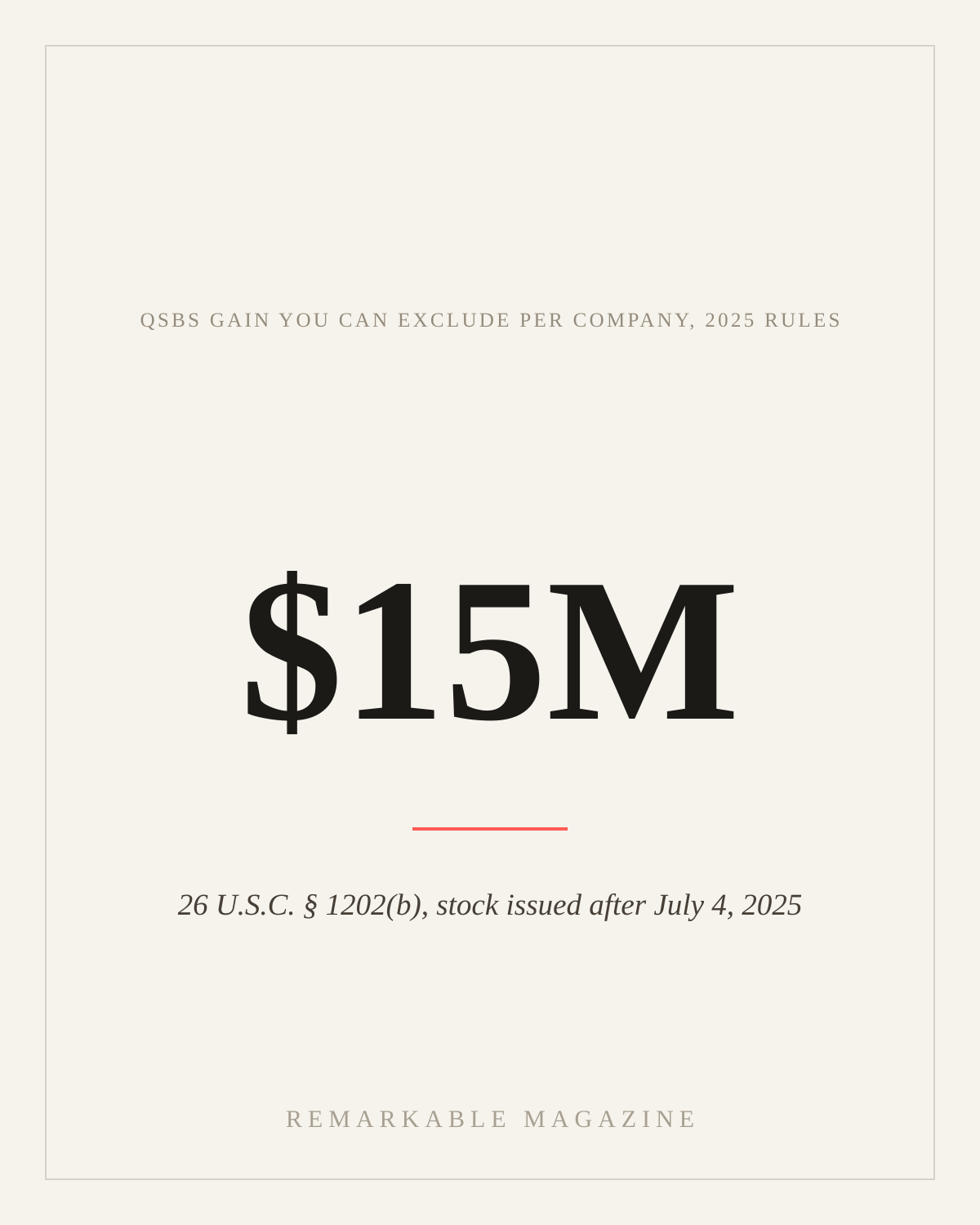
| Per-issuer cap | Greater of $10M or 10x basis | Greater of $15M or 10x basis |
| Company gross assets | $50M | $75M |
Per the statute, the $15 million and $75 million figures are adjusted for inflation for tax years beginning after 2026, and the dollar cap is reduced by any gain you have already excluded on the same company. Married taxpayers filing separately get half.
The older rules did not disappear: stock issued on or before July 4, 2025 stays under them, so a founder with shares from before and after that date holds two regimes at once.
Does your stock qualify?
Section 1202(c) and (d) set the tests. The ones that trip founders most often:
- C corporation. The stock must be in a C corporation, “originally issued” after August 10, 1993, in exchange for money or property (other than stock) or as pay for services. Buying shares from another holder generally does not qualify.
- Gross assets. The company’s aggregate gross assets (cash plus adjusted basis of other property) may not exceed $75 million at all times before the issuance and immediately after it, for stock issued after July 4, 2025. The test is applied at issuance, so a company that later grows past the limit does not lose QSBS status on shares already issued.
- Active business. At least 80% of assets by value must be used in the active conduct of a qualified trade or business during substantially all of your holding period. Excluded fields include services in health, law, engineering, accounting and financial services; banking, investing and leasing; farming; mining; and hotels and restaurants. Large holdings of portfolio securities or idle real property can also cause a failure.
- Redemptions. Buybacks from you or related people, or significant company buybacks around the issuance, can disqualify stock.
Many founders hear “software company, so we qualify.” The statute is more specific than that, and a company that holds a lot of idle cash or investments, or whose revenue comes from a disqualified service, can fail the active-business test even in a tech company.
A worked example (hypothetical)
The following is an illustration with round numbers, not any real company, and it ignores state tax, the net investment income tax and any alternative-minimum-tax effects. It uses the 20% federal long-term capital gains rate DWT cites as the standard rate.
Five-year hold. A founder receives stock worth $1 million (basis $1 million) in a qualifying company in 2026 and sells it for $20 million in 2031. The gain is $19 million. The cap is the greater of $15 million or 10 times basis ($10 million), so $15 million. The founder excludes $15 million and is taxed on $4 million: about $0.8 million at 20%, versus about $3.8 million with no exclusion.
Four-year hold. The same founder sells after four years, with a $10 million gain. The 75% tier excludes $7.5 million, leaving $2.5 million taxable at up to 28% (IRS) for roughly $0.7 million, versus $2 million at 20% with no exclusion. As DWT notes, the portion left taxable on a 50% or 75% sale is taxed at 28% rather than the standard 20%, so the partial tiers help less than the headline percentages suggest, but they are far better than the old rule, which gave nothing before five years.
Rolling over: Section 1045
If you sell QSBS held for more than six months, Section 1045 lets you elect to defer the gain by buying other QSBS within 60 days of the sale. Gain is recognized only to the extent proceeds exceed the cost of the replacement stock, and the deferred gain reduces the replacement stock’s basis. It does not apply to gain treated as ordinary income. This is a niche tool, and the 60-day window is unforgiving.
What to do before you need it
- Check the entity. Confirm the company is a C corporation and was when your stock was issued. If you are an LLC today, talk to a tax adviser before converting, since the clock starts at issuance.
- Record the facts at issuance. Keep a dated record of the company’s gross assets when each round closed. If the IRS asks years later, you want proof.
- Watch the active-business test. Large cash piles or unusual assets, and any move into an excluded field, are worth reviewing annually.
- Model your state. Davis Wright Tremaine lists Alabama, California, Mississippi and Pennsylvania as not conforming to the federal exclusion, New Jersey as starting January 1, 2026, and Hawaii, Massachusetts and New York as partial. State rules change, so check yours now.
- Avoid early redemptions. A founder buyout or a company repurchase near an issuance can disqualify stock.
- Count the holding period carefully. Each issuance of stock has its own date, and for post-July 4, 2025 stock the tier depends on whole years held.
Related reading
- How the 83(b) Election Actually Works: the other tax clock that starts when founder stock is issued.
- How Startup Vesting Actually Works: how founder shares are earned.
- Liquidation Preference Explained: who gets paid first, which decides how much gain there is to exclude.
Sourcing: the exclusion tiers, $15 million and 10x-basis cap, $75 million gross-asset test, C-corporation, active-business and redemption rules, and the inflation-indexing language are from the text of 26 U.S.C. § 1202 (Cornell LII), opened directly. The Section 1045 terms are from 26 U.S.C. § 1045 (Cornell LII), opened directly. The 28% maximum rate and Form 8949 code Q treatment are from the IRS (Topic 409 and the Form 8949 instructions), opened directly. The effective date, the 20% comparison rate and the state-conformity list are from Davis Wright Tremaine’s July 15, 2025 alert; the tiers, cap and threshold are corroborated by Gibson Dunn’s July 15, 2025 alert. The dollar examples are our own hypothetical arithmetic. This article is general information, not tax or legal advice; talk to a tax professional before relying on QSBS.
Frequently asked
What is QSBS?
Qualified small business stock is stock in a domestic C corporation, originally issued in exchange for money, property or services, that meets the gross-asset and active-business tests in Section 1202 of the Internal Revenue Code. Non-corporate holders who keep it long enough can exclude some or all of the gain when they sell.
How much gain can I exclude under Section 1202?
For stock issued after July 4, 2025, the cap per issuer is the greater of $15,000,000 (reduced by gain previously excluded) or 10 times the aggregate adjusted basis of the stock sold that year. For earlier stock the dollar figure is $10,000,000. The $15 million figure is adjusted for inflation for tax years beginning after 2026.
How long do I have to hold QSBS?
For stock issued after July 4, 2025: three years for a 50% exclusion, four years for 75%, five years or more for 100%. For stock issued on or before that date, the exclusion is 100% only after more than five years and nothing before.
Does an LLC qualify?
Not as an LLC taxed as a partnership. The stock must be stock of a C corporation. A founder who starts as an LLC generally has to convert to a C corporation, and the clock runs from when the stock is issued; confirm the mechanics with a tax adviser before converting.
Does QSBS apply in my state?
Not always. Davis Wright Tremaine's July 2025 analysis lists Alabama, California, Mississippi and Pennsylvania as not conforming to the federal exclusion, with New Jersey beginning conformity on January 1, 2026, and Hawaii, Massachusetts and New York conforming only partially. Check your state's current rules.