Paras Chopra gave up being CEO of his own company seven years before he gave up owning it. Both decisions turned out to be good for the company. Neither one was really about the company.
A one-person company with a $1,000 goal
Chopra started Wingify in Delhi in 2010. By his own account, in a 2017 Inc42 interview, his ambition for it was almost deliberately small: “My goal was to make INR 50K in the first month or $1,000 when I started Wingify in 2010. I just wanted to prove to myself that I was not a failure.” He cleared roughly four times that in month one, Inc42 reported, and reached $1 million in annual recurring revenue within eighteen months — on a product, VWO (Visual Website Optimizer), that let businesses A/B test and personalize their websites without an engineering team.
What makes the next decade notable isn’t the growth; plenty of SaaS companies grow. It’s that Wingify did it without raising a dollar of outside capital, a fact TechCrunch and every other outlet that has covered the company’s history reports as settled. Chopra personally interviewed nearly every hire until the team passed 120 people, per Inc42; by year five the company had roughly 150 employees, almost entirely unknown outside the SaaS and conversion-optimization niche it served, and almost entirely outside India — 90% of Wingify’s revenue has consistently come from the US and Europe, according to Wingify’s own public statements.
Handing off the job, keeping the title
On February 27, 2018, Wingify announced a leadership change on its own company blog. Sparsh Gupta, Wingify’s co-founder and chief operating officer for the two years prior, became CEO. Chopra became Founder and Chairman. “My title has changed to Founder and Chairman of Wingify,” Chopra wrote at the time. “My involvement in the company remains the same as it has been in the last many years — the team will see me in both offices and I’ll be available for discussion and mentorship for Wingify leadership and other employees.” Gupta, for his part, called it “a privilege of a lifetime” and said he was “looking forward to this fantastic opportunity of serving as the CEO of one of the most successful SaaS startups in India.”
It’s a small, easy-to-miss pivot point: a founder handing the operating job to a co-founder while staying close, seven years before he had any reason to think an acquisition was coming. But it’s the reason everything that follows was possible. By the time there was a company to sell, Chopra wasn’t the one running it.
What a bootstrapped decade was worth
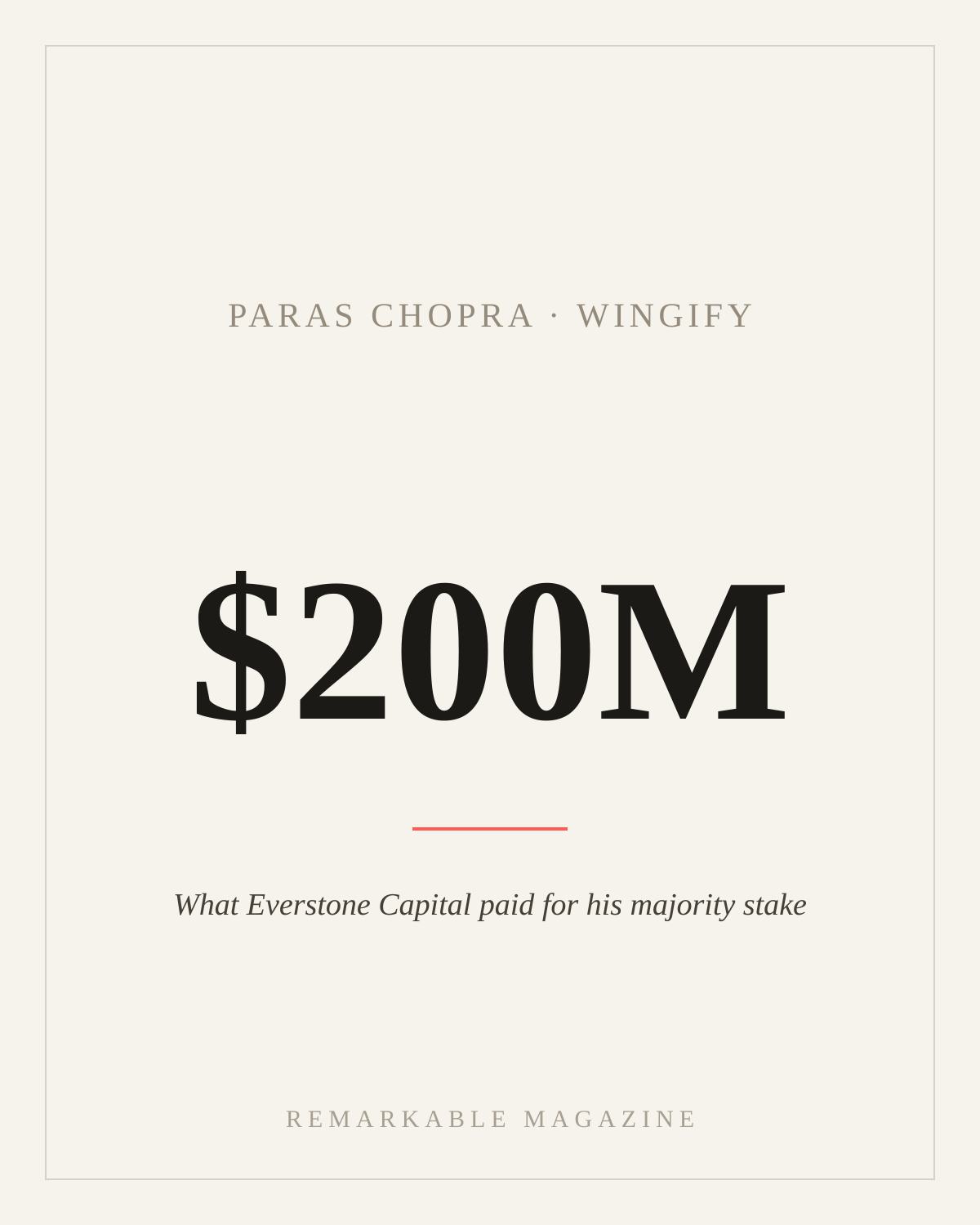
On January 24, 2025, Wingify announced that Everstone Capital, a Singapore-based private equity firm, had agreed to acquire a majority stake in the company. Neither party disclosed the price in its own release, but TechCrunch and Analytics India Magazine both independently reported the deal at roughly $200 million, with Chopra — who TechCrunch and Analytics India Magazine both reported held 71% of the company going into the deal — retaining a minority stake and a board seat. Wingify’s own announcement put the company’s annual recurring revenue above $50 million, with more than 4,000 customers worldwide across eleven offices.
Sandeep Singh, Everstone’s managing director, framed the deal around what bootstrapping had actually produced: “Wingify is among a select set of highly profitable software companies emerging out of India that have carved a leading position globally.” Gupta, now CEO in practice as well as title, said the partnership would “accelerate our expansion plans and further strengthen our global footprint.” Chopra’s own comment, released through the same announcement, looked forward rather than back: “I am confident that Sparsh and the Everstone team possess the expertise and vision to lead the business through its next phase of growth and success.”
The company didn’t need him to keep growing
What happened next is the part a 2025 press release couldn’t have predicted, and the part that makes Chopra’s bet legible in hindsight. In January 2026, per DealStreetAsia, Everstone combined Wingify with AB Tasty, a Paris-based experimentation and personalization company founded in 2013, into a single platform serving more than 4,000 customers with more than $100 million in combined annual revenue, according to DealStreetAsia and Inc42’s reporting. Gupta stayed on to lead the merged business as CEO; Wingify’s chief technology officer, Ankit Jain, became chief product and technology officer, while AB Tasty’s co-founders took the chief customer and chief revenue officer roles. Then, on March 27, 2026, the combined company’s board approved a further capital raise of roughly ₹1,381 crore — about $149 million, per Inc42’s conversion — led by Everstone’s Everdoc Pte. Ltd. vehicle, with Gupta and Jain themselves among the participants, according to Inc42 and Angel One.
Chopra’s name doesn’t appear in the reporting on either 2026 event. That’s the point. The company he spent fifteen years building has kept merging, raising and growing under someone else’s operating decisions, more than a year after he stopped owning a majority of it and eight years after he stopped running it day to day.
Where the time and the money went instead
Since 2024, Chopra has been running Lossfunk, a self-funded, unfunded AI research lab based in Indiranagar, Bengaluru. It isn’t a startup in any conventional sense — it has no product, no customers and no funding round of its own. It runs on fellowships, typically six months to a year, for researchers working on open questions in AI, intelligence and the foundations of science.
Chopra discussed the decision directly in a September 18, 2026 interview on the SparX podcast, hosted by Mukesh Bansal. “After selling Wingify, I thought I have time, I have money,” he said, describing the opening that let him finally act on an old interest. “Lossfunk is sort of like a culmination of these two dreams, let’s do science and let’s do science about AI,” he said of the lab’s purpose. Asked about how it actually operates, he described the fellowship structure plainly: “Fellowships range from six months to a year. And then internships also, they last like a similar point of time. And if there is a great fit, we extend it.”
The same interview carried a harder argument: that India’s AI ambitions are badly overmatched by the US and China. “Indians count but not India,” Chopra said. “We’re very far behind, unfortunately.” He’s made a related case publicly through the rest of 2026 — that the Indian IT services industry, a major share of the country’s exports, has no clear role to play if AI keeps advancing at its current pace. It’s an argument from someone with unusual standing to make it: a founder who built and then walked away from exactly the kind of profitable, outsourced-services-adjacent software business he’s now warning isn’t enough. Analytics India Magazine’s 2026 AIM 100 list, ranking him among the 100 most influential people shaping AI in India, credited him with becoming “one of the most influential independent voices on India’s AI future” over the preceding year.
Chopra’s trade isn’t the one this magazine’s other founders have made. He didn’t sell control and stay on, like Nima Jalali. He didn’t sell control and step back to an advisory seat, like Lucy Aylen. He gave up the operating job years before anyone offered to buy the company, then gave up ownership once the price was right, and spent what was left of his time and the money on something with no exit in sight at all.
Related founders
- Amjad Masad Stopped Teaching People to Code. Revenue Grew 50x. — another founder who reversed the mission his own company was built on, and watched the business outgrow his old identity for it.
- Marc Lou Was Fired in 2021. He Now Runs 15+ Startups Alone. — a different bet on building without outside money or a conventional team, at a much smaller scale.
- How Danny Postma Built HeadshotPro to $3.6M ARR — Alone — bootstrapped, solo, and still run day-to-day by its founder, the inverse of Chopra’s handoff.
Wingify’s 2010 founding, its growth without external funding, Paras Chopra’s early revenue goal and quote, and the company’s early headcount are per Inc42’s 2017 profile of Chopra. The February 27, 2018 leadership transition — Sparsh Gupta becoming CEO after two years as COO, Chopra becoming Founder and Chairman, and both men’s quotes on the change — is per Wingify’s own company announcement. The January 24, 2025 Everstone Capital majority-stake acquisition, Wingify’s reported annual recurring revenue above $50 million, its customer count above 4,000 worldwide, its revenue concentration in the US and Europe, and the quotes from Paras Chopra, Sparsh Gupta and Everstone managing director Sandeep Singh are per Wingify’s own announcement. The deal’s approximate $200 million value and Chopra’s 71% pre-deal ownership stake, not disclosed by either party, are corroborated independently by TechCrunch and Analytics India Magazine. The January 2026 merger of Wingify with AB Tasty, the combined platform’s customer count and revenue, and the resulting leadership roles are per DealStreetAsia’s reporting, corroborated by Inc42. The March 27, 2026 capital raise, its rupee and dollar amounts, and the identities of its participants are per Inc42, corroborated by Angel One. Lossfunk’s founding year, location and unfunded fellowship structure are per Tracxn’s company profile. Paras Chopra’s direct quotes on selling Wingify, founding Lossfunk, its fellowship structure, and India’s AI standing are per the transcript of his September 18, 2026 SparX podcast interview with Mukesh Bansal, published by The Singju Post. Chopra’s broader 2026 advocacy and his ranking on Analytics India Magazine’s AIM 100 2026 list are per Analytics India Magazine’s own profile of him. No Creative Commons or public-domain photograph of Paras Chopra was found on Wikimedia Commons; this post ships with a typographic card in place of a photograph.