Nima Jalali sold control of Salt & Stone and negotiated his way into staying exactly where he was, as CEO. Lucy Aylen made the identical trade at Never Fully Dressed. Shay Mitchell’s version of this deal looks similar from the press release and is actually a different shape entirely: she was never the chief executive of BÉIS, so there was no CEO’s chair for her to bargain to keep. What she bargained to keep was the job she’d always had.
An actress, an incubator, and a bag
BÉIS was founded in 2018 by the actress Shay Mitchell — best known for playing Emily Fields on Pretty Little Liars — in partnership with Beach House Group, the Los Angeles brand-incubation studio founded by Shaun Neff that specializes in building celebrity-attached consumer brands and then selling them. BÉIS built a travel and lifestyle luggage line around a recognizable, Instagram-forward aesthetic, and by Samsonite’s own account had amassed a social following of more than 1.4 million on Instagram and over 619,000 on TikTok by the time of the sale. Lifestyle bags made up roughly half of the brand’s net sales, with luggage making up most of the rest.
The structure matters for what happened next. Beach House Group, as the incubator, held the controlling stake — reported at roughly 70% — while Mitchell held a minority founder’s stake of around 30%. That split is why BÉIS’s sale isn’t a story about one founder cashing out; it’s a story about an incubator’s exit, with the famous name attached to the brand selling down alongside it.
The deal, and who actually sold what
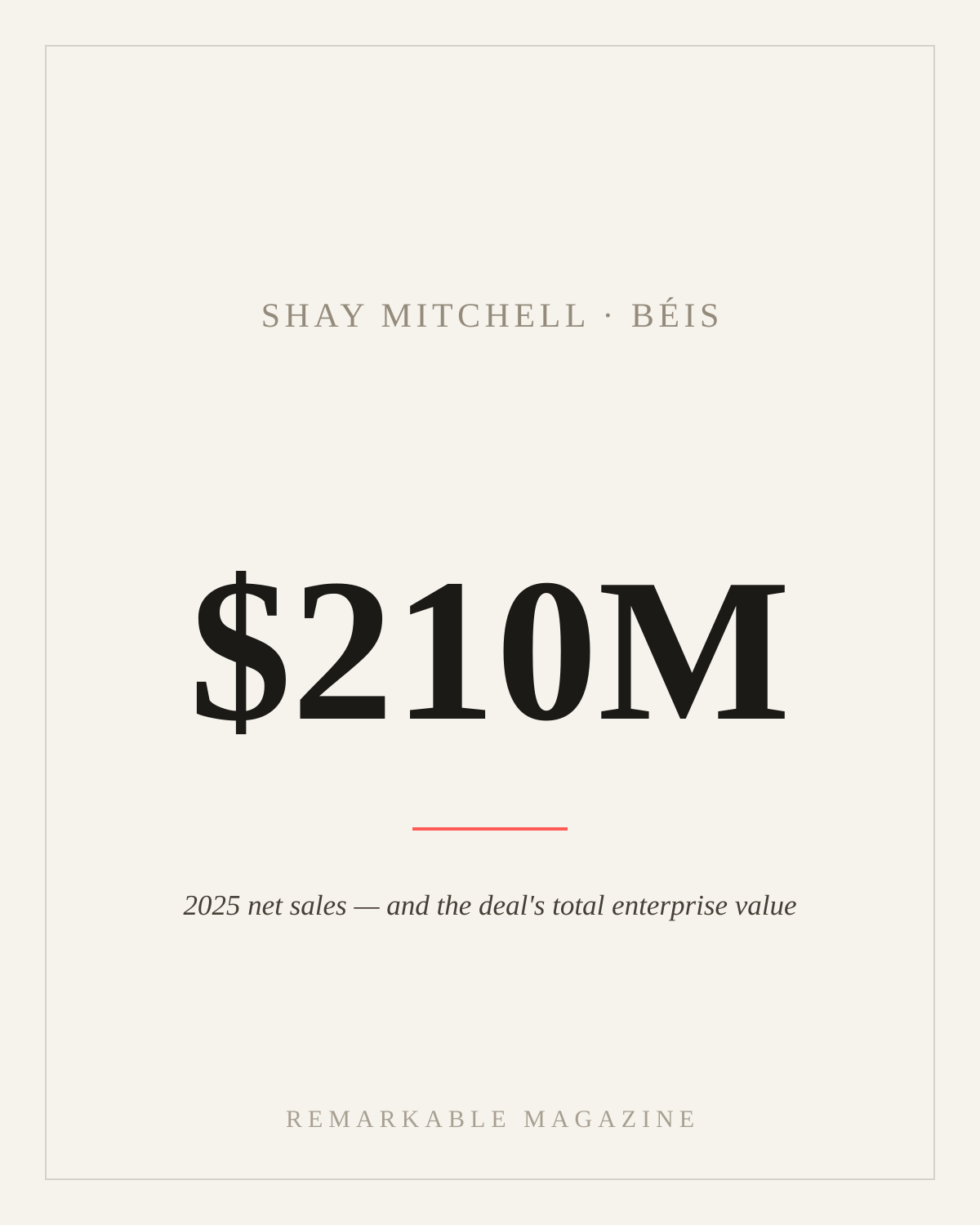
On August 12, 2026, Samsonite Group S.A. — the Hong Kong-listed luggage conglomerate — announced a definitive agreement to acquire 85% of BÉIS’s equity for $178.5 million in cash, funded from cash on hand and its revolving credit facility. The transaction carries a total enterprise value of approximately $210 million on a cash-free, debt-free basis. BÉIS had generated approximately $210 million in 2025 net sales — meaning the price Samsonite is paying values the eight-year-old brand at almost exactly one year of its own revenue.
Of the 85% Samsonite is acquiring, Beach House Group is selling its entire stake. Mitchell is rolling over roughly half of her own equity and selling the remainder, leaving her with a 15% stake once the deal closes. Samsonite’s chief executive, Kyle Gendreau, framed the acquisition around BÉIS’s “differentiated products and a best-in-class digital-first business model.” BÉIS will continue to operate as a standalone brand inside Samsonite’s portfolio, run by its existing CEO, Adeela Hussain Johnson, and management team. The deal is expected to close in the fourth quarter of 2026, pending regulatory approval.
Mitchell’s own statement on the sale, issued alongside the announcement, read: “This is a dream come true… I’m so proud of what our small but mighty team has built over the past eight years.” It’s the kind of line that, read quickly, sounds like an exit. Read against the deal terms, it’s closer to the opposite: Mitchell isn’t leaving BÉIS. She’s continuing as founder and Head of Creative and Design — a title that, notably, was never “chief executive” in the first place.
The job that didn’t change
That’s the detail that separates Mitchell’s deal from Jalali’s or Aylen’s. When a founder-CEO sells majority control and stays on as CEO, the headline is continuity of command: the person who ran the company before the sale still runs it after. Mitchell never ran BÉIS day to day in that sense — Hussain Johnson did, as CEO, both before and after the transaction. What Mitchell ran was the brand’s creative identity, and that’s precisely the seat Samsonite is paying to keep her in. The deal changes who owns BÉIS. It does not change who does what inside it.
It’s also, in a narrower sense, a story about Beach House Group’s business model working as designed. Neff’s studio builds consumer brands around a founder’s public profile and then sells them — BÉIS is reportedly its second brand exit, and its largest to date. For Mitchell, the sale is less a founder’s cash-out than a landlord’s: she keeps living in — and designing — the house, while the equity that financed building it changes hands around her.
Related founders
- Nima Jalali Sold Control of Salt & Stone. He Kept the Job. — the version of this trade where the founder actually was the CEO, and the sale’s whole point was proving he’d stay one.
- Lucy Aylen Sold Control of Her Brand. She Kept the Top Job. — the closest parallel on the CEO side of this pattern, five months earlier.
- Adanola’s Founder Gave Up the CEO Seat. Revenue Grew 48%. — the mirror case: a founder who kept his equity and handed the operating job to someone else entirely.
BÉIS’s 2018 founding, Shay Mitchell’s role as co-founder with Beach House Group, and Beach House Group’s history as a brand incubator founded by Shaun Neff are per Samsonite Group’s own August 12, 2026 acquisition announcement (distributed via PR Newswire and republished by regional outlets including the Orange Leader), corroborated by Entrepreneur, Pulse2 and Retail Touch Points. The $178.5 million cash price for 85% of BÉIS’s equity, the approximately $210 million total enterprise value, BÉIS’s approximately $210 million in 2025 net sales, Beach House Group’s roughly 70% stake being sold in full, Mitchell’s roughly 30% pre-deal stake being halved to a retained 15%, Adeela Hussain Johnson’s continuing role as CEO, and the expected fourth-quarter-2026 closing are per the same company announcement, corroborated independently by Entrepreneur, Pulse2, Retail Touch Points and FashionUnited. Mitchell’s quote (“This is a dream come true… I’m so proud of what our small but mighty team has built over the past eight years”) and Kyle Gendreau’s quote appear verbatim and consistently in the company announcement and in Hello Magazine’s coverage. No figure on Mitchell’s personal net worth, age, or family background appears in this piece — those are declined per this magazine’s sourcing guardrail regardless of search demand.