Most founders get one shot at building the brand that carries their name. Dr. Zein Obagi built two, and in 2026 he watched both of them sold within five months. The second, ZO Skin Health, went to Galderma on October 14 for an all-cash enterprise value of $1.5 billion. “ZO Skin Health has been my life’s work,” he said in Galderma’s announcement.
At a glance
| Company | ZO Skin Health, Irvine, California, founded 2007 |
| Founder | Dr. Zein Obagi, dermatologist |
| Buyer | Galderma (100%) |
| Sellers | Blackstone Tactical Opportunities funds and the Obagi family |
| Price | $1.5 billion enterprise value, all cash |
| Net sales | About $330 million, twelve months to June 2026 |
| Closing | Expected Q4 2026 or early 2027 |
The first company
Obagi trained as a physician in Damascus, graduating in 1972, and moved to the United States for further training, per Wikipedia. In 1985 he developed the Obagi Nu-Derm System, a prescription-strength skincare regimen, and in 1988 he founded WorldWide Products to sell it. In 1997 he sold that company to an investor group and stayed on as medical director. It was renamed Obagi Medical Products.
The arrangement didn’t last. Wikipedia records that he left in 2006, after his role diminished and, in its words, the company had “strayed from his original goals.” In 2007 he started over with ZO Skin Health. He kept the expertise and the reputation; the brand with his surname stayed with the company he’d sold.
The second company, and its sale
ZO sells through doctors’ offices and medical spas rather than store shelves. Per Galderma, it has more than 40 products made in the U.S., more than 16,500 physician, medical spa and online accounts, and distribution in over 40 countries.
Blackstone bought a majority stake in 2020, at an undisclosed price, and says revenue “more than doubled” under its ownership, per the Orange County Business Journal. Galderma is buying the whole company from Blackstone’s funds and the Obagi family. The deal is expected to be neutral to Galderma’s core earnings per share in the first full year, and the buyer says it will invest more commercially in year one to “reignite” growth, in the words of CEO Flemming Ørnskov.
Two Obagi brands, one year
Four and a half months before the ZO deal, the other company changed hands too. On June 1, 2026, Waldencast agreed to sell Obagi Medical to private equity firm Bridgepoint for an enterprise value of up to $460 million, per Cosmetics Business. Obagi Medical had $161.6 million of net revenue in 2025, up 8.3%, and $19.4 million of adjusted EBITDA, per Waldencast’s full-year 2025 results.
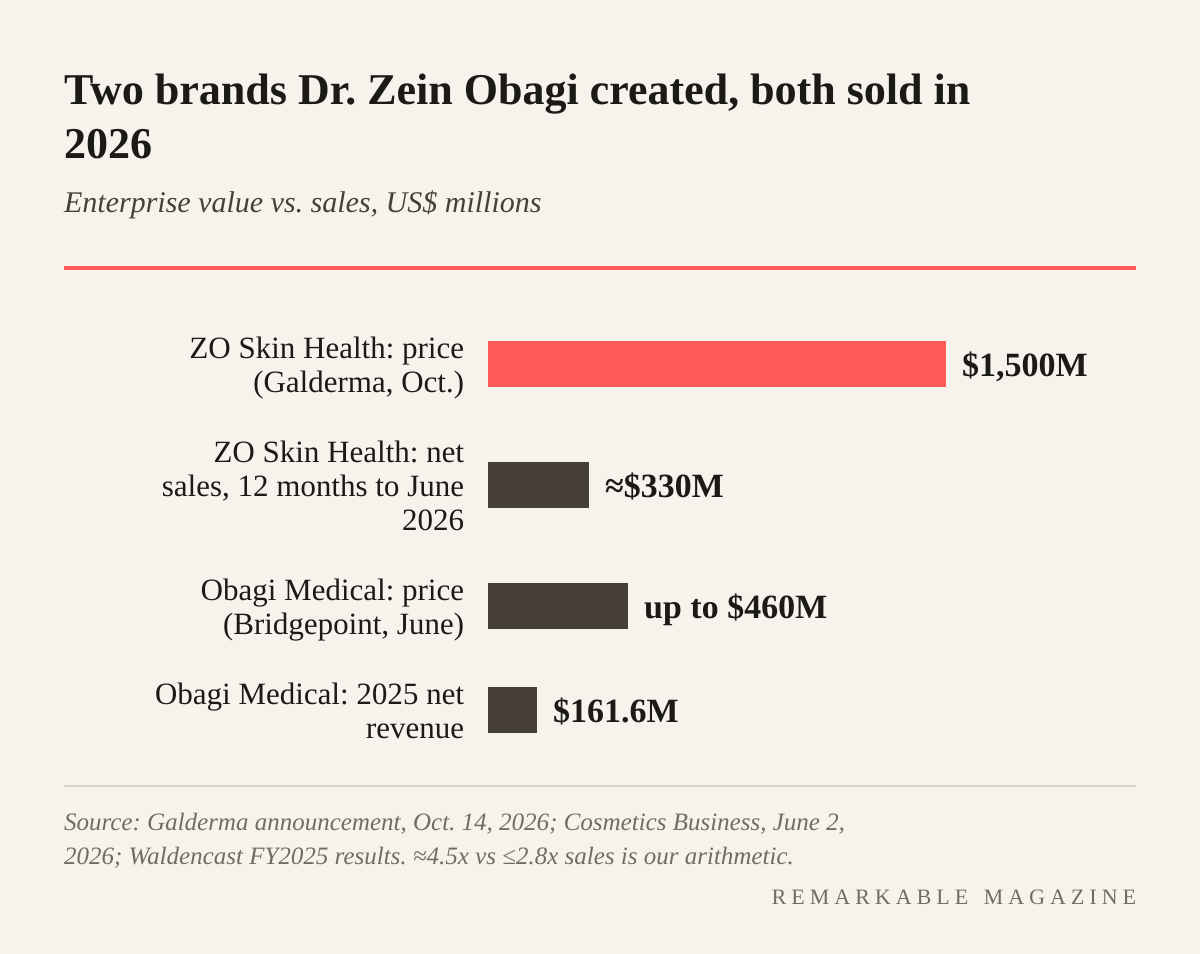
Divide price by sales and the gap is plain. ZO Skin Health sold for about 4.5 times its trailing net sales; Obagi Medical for at most about 2.8 times its 2025 revenue. That is our calculation from the disclosed figures, and the two periods differ slightly (ZO’s is the twelve months to June 2026, Obagi Medical’s is calendar 2025). Obagi Medical’s price is a ceiling, since it includes contingent payments.
The company he left behind is the smaller one now. The one he started again from nothing, 19 years ago, sold for more than three times as much.
What founders can take from it
- Selling the company can mean selling your name. Obagi sold the business carrying his surname in 1997 and had to build his second brand under initials.
- Staying on after a sale is not the same as keeping control. He remained medical director at the first company for about nine years and left when its direction moved away from his.
- Channel can be the moat. ZO is sold through physicians and med spas, the channel Galderma says it bought the brand for.
Related founders
- Iskra Lawrence Is Selling Control of Saltair. She Keeps a Title.: another 2026 skincare and body-care sale to an investor.
- Nima Jalali Sold Control of Salt & Stone. He Kept the Job.: a founder who sold a majority to private equity and stayed.
- Eric Baker Was Fired From StubHub. He Bought It Back.: another founder who lost the first company and came back bigger.
Sourcing: deal terms, sellers, ZO’s sales, product and account counts, closing timing, the EPS guidance and the quotes from Dr. Obagi and Flemming Ørnskov are per Galderma’s October 14, 2026 announcement, opened directly at galderma.com. Blackstone’s 2020 majority stake and its “more than doubled” revenue claim are per the Orange County Business Journal (Nancy Luna, October 14, 2026). Dr. Obagi’s education, the 1985 Nu-Derm system, the 1988 founding, 1997 sale, 2006 departure and 2007 founding of ZO are per Wikipedia. The Obagi Medical sale terms are per Cosmetics Business (June 2, 2026); its 2025 revenue and adjusted EBITDA are per Waldencast’s Q4 and FY 2025 results release. The sales multiples are our own arithmetic from those figures. No portrait is used: we found no licensed photograph of Dr. Obagi.
Frequently asked
Who is buying ZO Skin Health?
Galderma, the Swiss dermatology company behind Cetaphil and Alastin. It agreed on October 14, 2026 to buy 100% of ZO Skin Health for an enterprise value of $1.5 billion in cash, funded from cash and bank financing. Closing is expected in the fourth quarter of 2026 or early 2027, subject to regulatory approvals.
Who founded ZO Skin Health?
Dermatologist Dr. Zein Obagi founded ZO Skin Health in 2007, per Wikipedia. Galderma's announcement lists him as Founder and Medical Director. He had earlier created the Obagi Nu-Derm System and the company that became Obagi Medical Products.
Is ZO Skin Health the same company as Obagi Medical?
No. Obagi Medical grew out of WorldWide Products, the company Dr. Obagi founded in 1988 and sold to an investor group in 1997, per Wikipedia. He left it in 2006 and founded ZO Skin Health in 2007. In 2026 the two were sold separately: Obagi Medical to Bridgepoint for up to $460 million, ZO Skin Health to Galderma for $1.5 billion.
How much revenue does ZO Skin Health make?
About $330 million in net sales in the twelve months to June 2026, per Galderma. It sells more than 40 products through more than 16,500 physician, medical spa and online accounts in over 40 countries.