Michael Preysman learned that the company he founded was being sold to Shein about a week before everyone else. He wasn’t on the board by then and had no say. A spokesperson told Retail Dive he was “appalled.” Within days he had a new website up, and the first sentence on it was the whole story: “I started Everlane in 2011.”
At a glance
| Brand | Everlane, San Francisco apparel, launched 2011 |
| Founders | Michael Preysman and Jesse Farmer |
| Buyer | Shein, majority stake |
| Seller | L Catterton (majority owner since 2024) |
| Reported price | $100 million (Puck; not confirmed by Everlane) |
| Debt at sale | About $90 million |
| Founder’s role after | None; he left the board earlier in 2026 |
The brand that showed you the factory
Preysman and Jesse Farmer started Everlane as an online menswear shop built on one idea, transparent pricing, per Wikipedia’s summary of early coverage. The brand published what its clothes cost to make and where they were made, and called the approach “radical transparency.” The pitch, as The New York Times put it, was a transparent alternative to Gap, sold direct to consumers, and it landed with millennial women in particular. At its high point Everlane was valued at $250 million, in 2016.
Preysman ran the company as CEO for 11 years and then spent three as executive chair, according to Retail Dive. Wikipedia dates his step-down as CEO to January 2022.
How the founder’s company became a private equity asset
The ownership changed in two steps. L Catterton, the private equity firm backed by LVMH, bought into Everlane at the end of 2020 and became its majority owner in 2024, per Wikipedia’s account. The debt grew alongside. By the spring of 2026, Everlane owed about $90 million: a $25 million loan from Gordon Brothers and a $65 million asset-backed revolving credit facility, FashionUnited reports, citing Vogue Business. L Catterton had been looking for a new investor since March.
The investor it found was Shein. Puck’s Lauren Sherman reported on May 17 that Everlane’s board had approved a $100 million sale. The Next Web, summarising Puck’s reading of the note sent to shareholders, says common stockholders would receive no payout. Everlane confirmed the deal to staff on May 22. CEO Alfred Chang wrote in an internal message: “I want to be clear: Everlane will remain Everlane.”
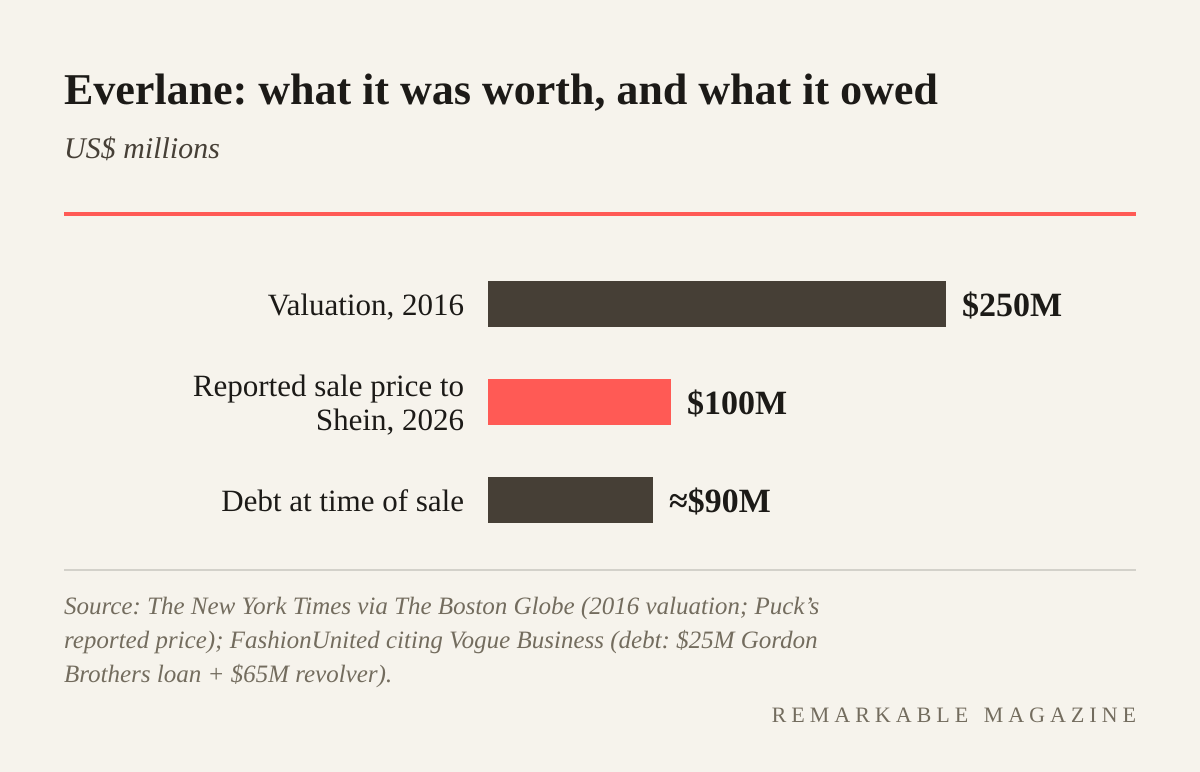
Read together, those three numbers explain the outcome. A brand once valued at $250 million sold for a reported $100 million while carrying about $90 million of debt. Lenders and preferred investors get paid before common stock, so a price that close to the debt left little or nothing for common holders, which is consistent with what Puck reported. The $100 million is a reported figure; neither company disclosed terms.
Starting over, on different terms
Preysman’s new site, stillradical.com, is one paragraph and an email box. “I started Everlane in 2011. On May 29th, the current management team sold it to Shein. So we’re starting over,” it reads. “Same principles, but a new take. And this time: no venture capital, no private equity.”
The name points back at Everlane’s old tagline. When Retail Dive reported on it on May 26, the site was not selling anything and nearly 4,000 email addresses had been shared.
Not every observer thought the problem started with Shein. “They’d been transitioning to fast fashion long before Shein even entered the picture,” DeAnn Campbell of StoreWyse told Retail Dive. Neil Saunders of GlobalData told the Times he was not surprised Everlane was sold, given its debt and performance. The buyer was the surprising part.
What founders can take from it
- Control leaves before the founder does. Preysman stepped down as CEO in 2022 and lost any say in the sale once he left the board. The decision that ended his brand’s independence was made by the cap table he had built, not by him.
- Debt decides who gets paid. With a reported price only about $10 million above the company’s debt, there was little left for common stock. Founders who sell shares early should know where they sit in that order.
- Values are not transferable assets. Everlane’s management says its sustainability commitments survive. The founder’s answer was to write “no private equity” into his next company’s first paragraph.
Related founders
- Dennis Crowley Says Foursquare’s Sale Paid Equity Holders Nothing: another founder watching from outside as a private equity-era sale returned nothing to common stock.
- Ben Francis Sold 21% of Gymshark. Now He Wants It Back.: a founder working the other way, trying to buy back what he sold to private equity.
- Nima Jalali Sold Control of Salt & Stone. He Kept the Job.: a founder who sold control to private equity and stayed on.
Sourcing: the board approval, $100 million price and shareholder note are Puck’s reporting (May 17, 2026), relayed by The New York Times via The Boston Globe (May 22) and The Next Web (May 18); we could not open Puck itself. The $250 million 2016 valuation, Alfred Chang’s statements to the Times and the Saunders quote are per the Times/Globe. The $90 million debt breakdown and Chang’s internal message are per FashionUnited citing Vogue Business. Preysman’s tenure, the spokesperson’s “appalled,” the Campbell quote and the Still Radical sign-up count are per Retail Dive (Daphne Howland, May 26, 2026). The Still Radical text was read directly on stillradical.com on October 28, 2026. L Catterton’s 2020 entry, 2024 majority and the January 2022 CEO transition are per Wikipedia’s Everlane article. No portrait is used: we found no licensed photograph of Preysman.
Frequently asked
Who owns Everlane now?
Shein. Everlane told staff in May 2026 that Shein was buying a majority stake from L Catterton, the LVMH-backed private equity firm that had been majority owner since 2024, per FashionUnited citing Vogue Business. CEO Alfred Chang stayed in his role and said the brand would remain independent.
How much did Shein pay for Everlane?
The price was not disclosed. Puck reported it at $100 million, as relayed by The New York Times (via The Boston Globe) and The Next Web. Everlane was valued at $250 million in 2016.
Was Michael Preysman involved in the Everlane sale?
No. Retail Dive reports he was CEO for 11 years and executive chair for three, left the board earlier in 2026, and learned of the Shein sale the week before it was confirmed. A spokesperson said he was 'appalled.'
What is Michael Preysman doing after Everlane?
He launched a placeholder site for Still Radical, a new apparel brand. The site says: 'Same principles, but a new take. And this time: no venture capital, no private equity.' It was collecting email sign-ups and not yet selling clothes when Retail Dive reported on it on May 26, 2026.