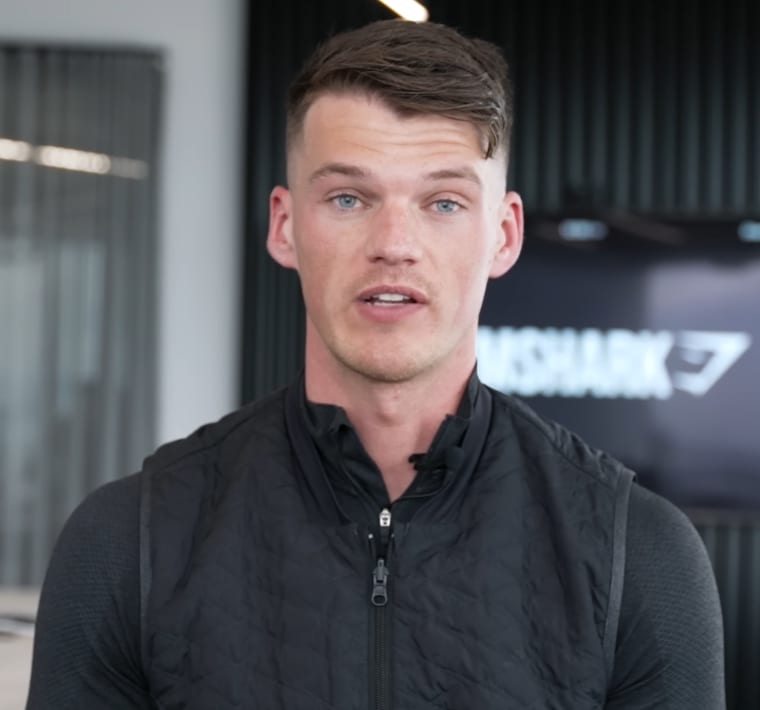
The most-told part of the Gymshark story is the garage. It is worth telling because it is true, and because almost nothing about it looks like a plan.
Ben Francis was born in 1992 in the West Midlands, joined his local gym at 17, and enrolled at Aston University in Birmingham at 18 — delivering pizzas for Pizza Hut at night to pay for it. He and a friend, Lewis Morgan, started an online business reselling supplements bought in bulk, under the name Gymshark. It worked well enough to be a business and not well enough to be interesting.
The pivot came from a problem Francis had as a customer. He could not buy the clothes he wanted. “Bodybuilding wear just wasn’t available here,” he told Forbes. So the two of them bought a sewing machine and a screen printer with their savings — the printer paid for with money from his grandmother — and started making it in his parents’ garage. His mother sent him videos to teach him to sew.
The expo, and the two numbers
The moment Gymshark stopped being a hobby is dated and measurable.
In 2013, Francis and Morgan rented a booth at BodyPower, Europe’s largest bodybuilding expo, held in Birmingham. They sold out. According to Forbes, daily sales went from roughly $450 to roughly $45,000 after the event — a hundredfold step change from a single weekend in front of the exact people the product was designed for.
That is the whole strategy in miniature, and Francis has never really deviated from it: go to where the community already is, rather than trying to buy attention from outside it.
Paying YouTubers $500 a month
The second decision is the one that built the brand, and it looked ridiculous at the time.
“All my heroes were YouTubers, so I’d send them products,” Francis told Forbes. Gymshark paid fitness influencers as little as $500 a month to wear the clothes in their videos, and gave gear away free to weightlifters with real audiences. This was years before the major sportswear brands understood that a YouTuber who actually lifted could be worth more to a gym-clothing company than a stadium sponsorship.
It worked because it was not really marketing. The people wearing Gymshark in those videos were the same people the clothes had been cut for. Francis was one of them.
The stake, and the second act
By 2019 Gymshark was doing $214 million in revenue on $18 million of net income. In 2020, General Atlantic bought a 21% stake for nearly $300 million, valuing the company above £1 billion — and it is the deal Francis is now trying to partially reverse.
Francis had stepped out of the CEO seat in 2017 to become Chief Brand Officer, then returned as CEO in 2021. The year he came back, revenue grew 78% to $608 million and net income doubled to $68 million.
Since then the picture has been more complicated, and the accounts say so plainly. Revenue for the year to July 2024 was £607.3 million with pre-tax profit of £11.8 million — down from £13 million the year before and £27.8 million the year before that. Revenue for the year to July 2025 rose 6.6% to £647 million, and pre-tax profit fell again, to £6.9 million. That is a third consecutive year of declining profit against rising revenue, through a restructuring that cut hundreds of jobs and a retail buildout that included a Regent Street flagship in London.
Francis’s own framing of the FY24 numbers, given when they were filed, was about the top line and the adjusted figure: “Despite well-reported economic turbulence, FY24 represented another strong year of growth for Gymshark. We broke the £600m barrier for the first time, and adjusted EBITDA rose by double-digit numbers.”
Buying back what he sold
In July 2026, Forbes, citing reporting from the Financial Times, said Francis was negotiating with General Atlantic to repurchase a portion of the 21% stake — and meeting with banks about how to finance it.
Read against the profit line, that is a striking thing to want. Gymshark’s margins are compressing, competition has intensified, and the obvious move for a founder holding 70% of a slowing business is to take chips off the table, not to borrow money buying more of it.
It is consistent, though, with how Francis has talked about the company for years. Asked about his legacy in a 2021 interview with Thought Economics, he redirected the question entirely: “I don’t think much about my own legacy, I think about Gymshark.” In the same conversation he made the case against building by committee — “if you only listen to the voices around you, you’ll amalgamate them into something that already exists” — and put it more bluntly still: “My view was that consensus isn’t going to build something that will change the game.”
That is a founder describing why he does not want a large outside shareholder, five years before he started calling banks about it. Francis is worth $1.2 billion by Forbes’ reckoning and is Britain’s youngest billionaire; the thing he appears to want is not liquidity. It is a longer holding period than a 2020 valuation implied — which requires owning more of the company than he currently does.
He has also been open, in the same interview, about the only skill he thinks the job actually requires: “Entrepreneurs and founders have to learn to be the most adaptable people in their business.” A screen printer in a garage, then supplements, then a stand at BodyPower, then free hoodies for YouTubers, then a CEO seat handed over and taken back, then a retail estate, then an attempt to unwind the deal that made him rich. It is not a straight line, and it was never supposed to be.
Related founders
- Adanola’s Founder Gave Up the CEO Seat. Revenue Grew 48%. — the Manchester activewear rival that hired Gymshark’s own former chief commercial officer as its new CEO, and grew 48% the year that hire took over.
- Lucy Aylen Sold Control of Her Brand. She Kept the Top Job. — another UK DTC founder who sold a stake to outside capital and, unlike Francis, is not the one trying to buy it back.
- $300, a Crockpot, $10M: Oliver Zak’s Mad Rabbit Origin Story — another consumer brand built for a community its founders belonged to, before anyone else took that community seriously as a market.
- How Dagne Dover’s Founders Chose Patient Capital Over VC — founders who made the opposite call on ownership from the start, and why the shape of the capital changes the shape of the company.
- Seventy Startups, Four Winners: How Pieter Levels Built $3M/Year by Shipping More — the extreme version of keeping control: no investors, no employees, no stake to buy back.
Francis’s birth year and region, joining a gym at 17, enrolling at Aston University at 18, the Pizza Hut job, the supplements business with Lewis Morgan, the sewing machine and screen printer, the 2013 BodyPower expo and the $450→$45,000 daily sales figures, the influencer payments of as little as $500 a month, the “All my heroes were YouTubers” quote, the 2019 and 2021 revenue and net income figures, and the 2020 General Atlantic 21% stake at a $1.45 billion valuation are per Forbes (Giacomo Tognini, April 5, 2023). His grandmother funding the screen printer and his mother sending sewing videos are per CNBC’s May 26, 2023 profile. The FY24 accounts — £607.3 million revenue, £11.8 million pre-tax profit, prior-year comparatives and Francis’s quote on those results — are per BusinessCloud’s report of the Companies House filing. The year-to-July-2025 figures of £647 million revenue and £6.9 million pre-tax profit, the nearly $300 million General Atlantic paid in 2020, Francis’s more-than-70% holding, the restructuring and job cuts, the Regent Street flagship, his 2017–2021 stint as Chief Brand Officer and 2021 return as CEO, his $1.2 billion net worth, and the July 2026 report that he is negotiating a buyback and meeting banks about financing are per Forbes (Robert Olsen, July 4, 2026), which credits the Financial Times for the buyback reporting. His quotes on legacy, consensus and adaptability are per Thought Economics’ interview with Francis, published 13 May 2021. No figure in this piece is drawn from an unattributed estimate.