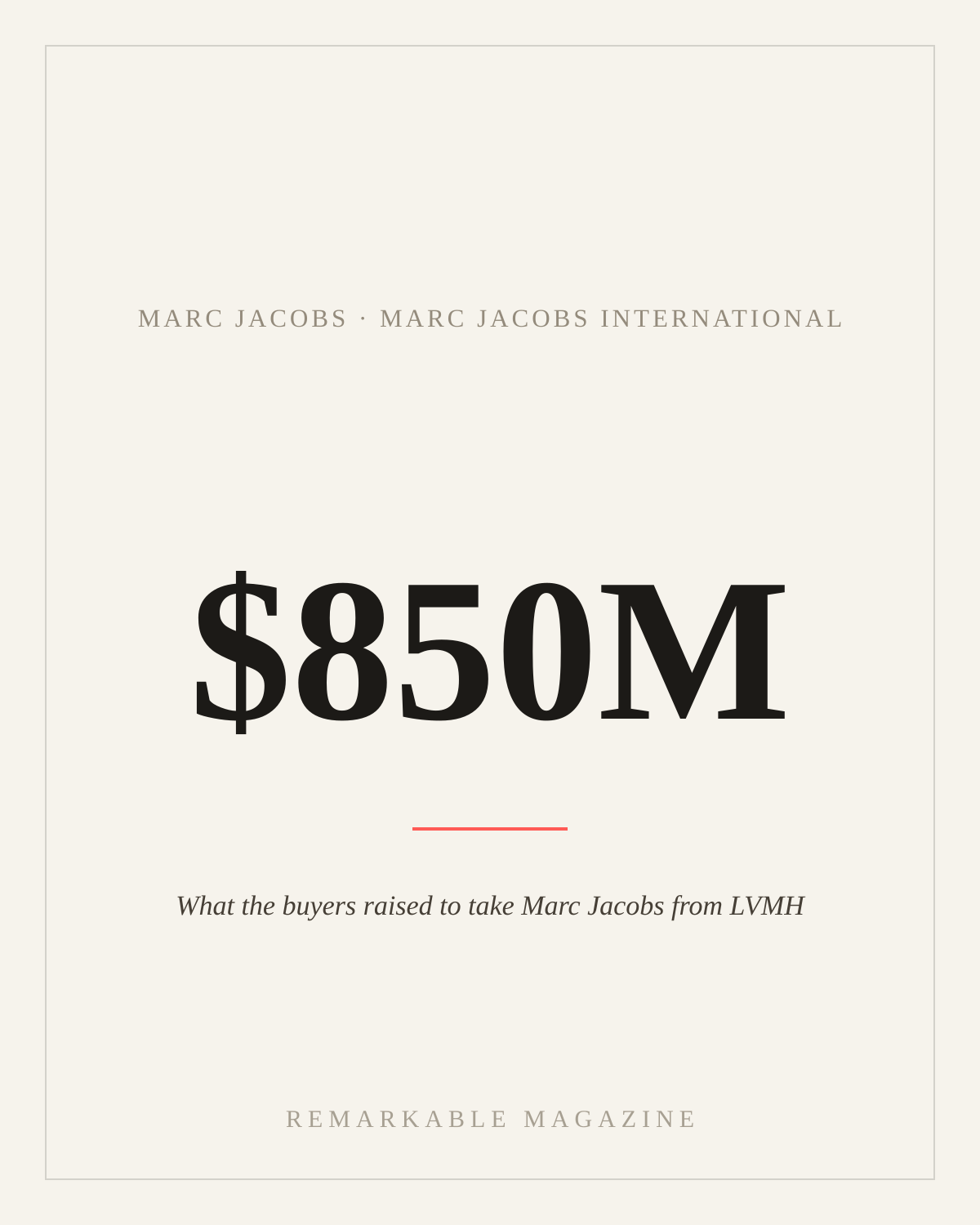
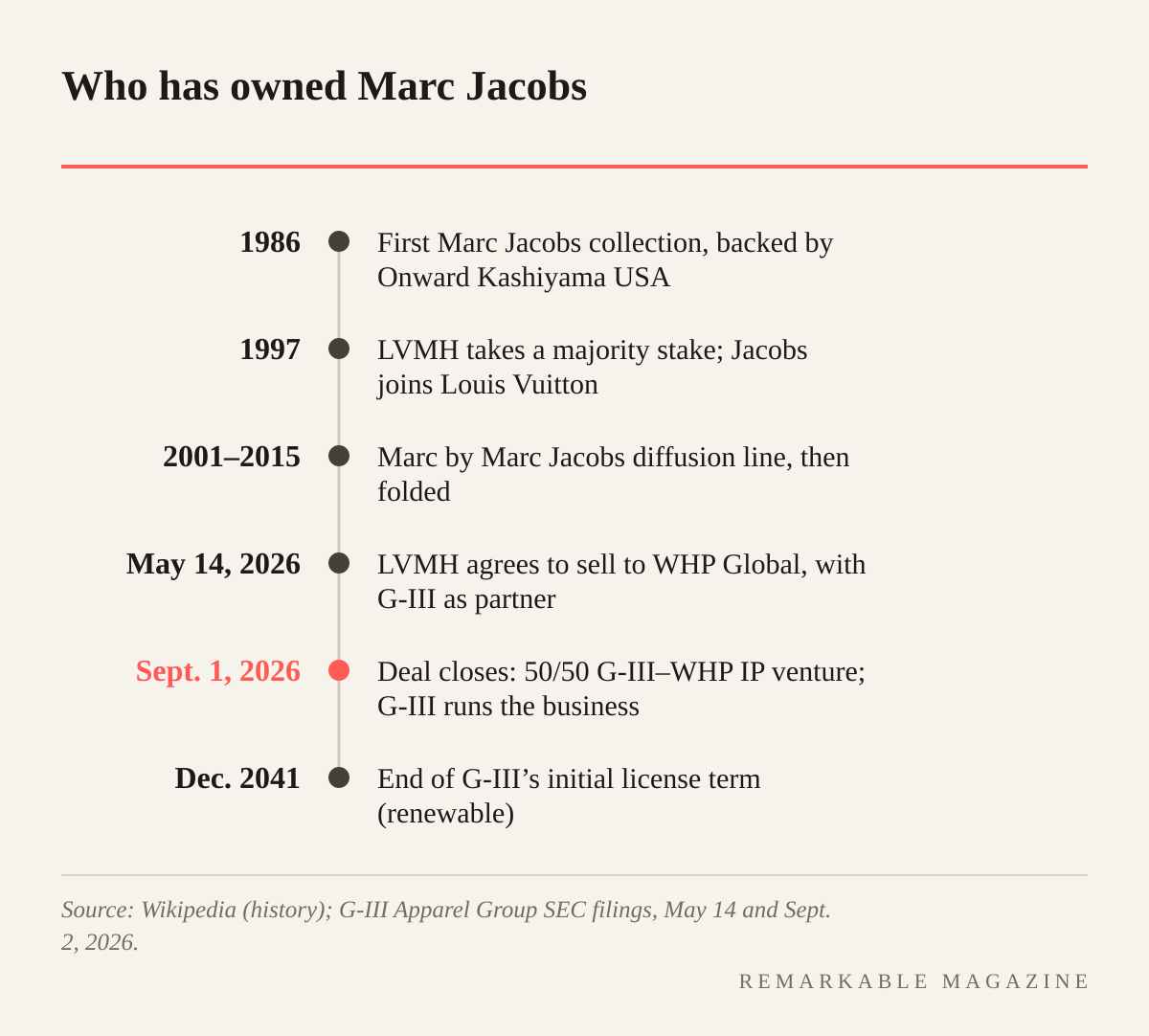
For 29 years Marc Jacobs designed under someone else’s ownership. LVMH bought control of his label in 1997, the year it also made him creative director of Louis Vuitton. On May 14, 2026, it agreed to sell, and on September 1 the brand passed to a licensing company and a New York apparel maker. The designer stays: The Fashion Law reports Jacobs remains creative director.
At a glance
| Brand | Marc Jacobs, New York, founded 1984 |
| Founder | Marc Jacobs, creative director |
| Seller | LVMH, controlling owner since 1997 |
| Buyers | WHP Global and G-III Apparel Group |
| Money raised | Up to $850 million (Reuters, The Fashion Law) |
| G-III’s investment | About $500 million |
| Closed | September 1, 2026 |
| License | Exclusive to G-III in the US, Canada, Mexico and Western Europe through December 2041 |
From Perry Ellis to Louis Vuitton
Jacobs, born in New York in 1963, built his name early. With his business partner Robert Duffy he formed Jacobs Duffy Designs in the mid-1980s and showed the first Marc Jacobs collection in 1986, per Wikipedia. He ran Perry Ellis’s women’s line from 1988 to 1993. In 1997 LVMH took a majority stake in his label and made him Louis Vuitton’s first creative director, a job he kept until 2014.
The brand grew and then narrowed. The diffusion line Marc by Marc Jacobs, launched in 2001, was estimated to make about 80% of the brand’s revenue by 2013, Reuters reported at the time. It was folded in 2015 so the company could concentrate on the main, more expensive line.
How the deal is built
The structure separates the name from the business. G-III’s May 14 announcement, filed with the SEC, set it out: WHP Global buys Marc Jacobs from LVMH, a 50/50 G-III and WHP joint venture holds the intellectual property, and G-III buys the operating business, the stores, e-commerce and wholesale, from that venture and licenses the name back. WHP runs the licensing. G-III’s investment is about $500 million, from cash and its credit line; Morgan Stanley committed debt for WHP’s side.
G-III’s Form 8-K of September 2 records closing on September 1. The joint venture’s board has five managers, two from G-III and three from WHP, and neither partner can generally sell units for three years. G-III’s license covers the US, Canada, Mexico and Western Europe and runs through December 2041, with ten automatic five-year renewals available. No brand revenue figures or royalty rates were disclosed. G-III’s results release the same day set a target of $1 billion in long-term annual revenue for the brand and said the deal will be slightly dilutive in its fiscal 2027.
“Marc Jacobs is one of the most influential names in fashion,” said G-III chairman and CEO Morris Goldfarb. “LVMH has been an exceptional steward of the brand.”
What founders can take from it
- The name and the business can be sold separately. Here the intellectual property sits in one company and the stores in another, linked by a license that runs to 2041.
- A founder can outlast his owners. Onward Kashiyama backed his first collection, LVMH controlled it for 29 years, and now G-III and WHP own it. Jacobs is still the designer.
- Licensing buyers pay for reach. G-III’s $1 billion revenue target is a bet that the name can sell far more product than it does today.
Related founders
- Tory Burch Is Buying Out General Atlantic for $346 Million: another New York designer’s company, moving the other way on ownership.
- Charlotte Tilbury Is Selling Her Brand to Puig, Slice by Slice: a founder-named brand owned by a European group, with the founder still in charge.
- Founder Exits of 2026: 23 Deals and What Founders Kept: the year’s founder ownership deals in one table.
Sourcing: deal structure, G-III’s ~$500 million investment, funding, Morgan Stanley’s financing commitment, the 1984 founding, advisers and the Goldfarb quotes are per G-III’s May 14, 2026 press release (SEC exhibit 99.1). The September 1 closing, joint-venture governance and license terms are per G-III’s Form 8-K filed September 2, 2026; the $1 billion target and fiscal 2027 dilution are per its exhibit 99.1 of the same date. All three were opened directly on sec.gov. The $850 million raised, the $425 million per-partner figure and Jacobs staying as creative director are per The Fashion Law’s 2026 deal timeline, which cites Reuters for the $850 million. Biography, the 1997 LVMH stake, Louis Vuitton tenure and the Marc by Marc Jacobs history are per Wikipedia’s Marc Jacobs (brand) article and its citations. No portrait is used.
Frequently asked
Who owns Marc Jacobs now?
Since September 1, 2026, a 50/50 joint venture of G-III Apparel Group and WHP Global owns the Marc Jacobs intellectual property, and G-III owns and runs the operating business under a license from that joint venture, per G-III's Form 8-K. LVMH, which had controlled the brand since 1997, sold it.
How much was Marc Jacobs sold for?
The total price was not disclosed. Reuters and The Fashion Law report that the buyers raised up to $850 million, with each partner able to contribute up to $425 million. G-III describes its own investment as approximately $500 million.
Is Marc Jacobs still the creative director of his brand?
Yes. The Fashion Law reports that Marc Jacobs stays on as creative director after the sale. G-III's filings do not address his role.
When did LVMH buy Marc Jacobs?
LVMH took a majority stake in 1997, the same year it named Jacobs the first creative director of Louis Vuitton, a role he held until 2014, per Wikipedia's citations of Reuters and British Vogue.