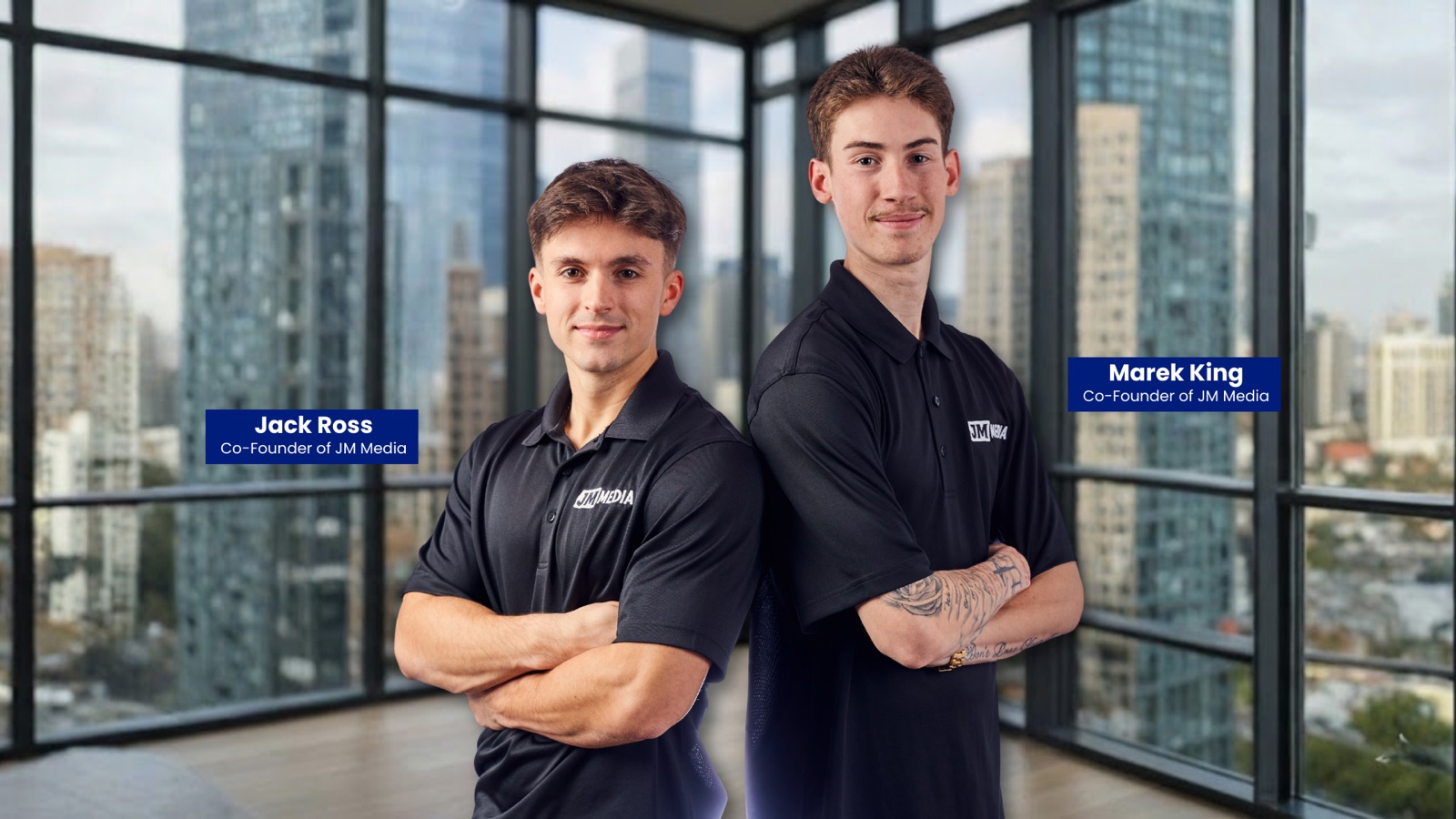
The founding conversation happened across four time zones. Jack Ross was in Vancouver, running a detailing business and working in the trades. Marek King was almost five thousand kilometres east in New Brunswick, working in the trades in his father’s business. Neither of them knew anything about marketing.
“About two years ago, we asked a simple question: what if we started a marketing company?” they told Remarkable Magazine.
What followed was roughly six months of a schedule that is easy to describe and hard to keep. Work the day. Study the night. “We spent roughly six months working during the day and studying marketing at night, often until two or three in the morning,” they said. “We took courses, learned advertising, sales, websites, lead generation, customer acquisition, CRM systems, and follow-up.”
Then came the decision that actually made the company. After testing several industries, they stopped trying to serve everyone and went back to the one they had been standing in the whole time.
“We had seen excellent tradespeople struggle to grow because they depended almost entirely on referrals,” they said. Contractors and home-service businesses became the whole focus. JM Media, they say, was built to give those businesses “a more predictable way to attract leads, follow up, and turn opportunities into paying customers.”
Free trials, because trust has to be earned first
Two young founders with no case studies have exactly one asset: the willingness to work for free until they have some.
“In the early days, we did not have a large audience, a long track record, or years of case studies,” they said. They started with their own network and with businesses prepared to take a chance on them. The first client was a home-service company doing custom renovations and interior remodelling.
They also gave away free trials — deliberately. “We knew trust had to be earned before it could be requested.”
Their read on that period is worth repeating to anyone in month one of anything: “Instead of trying to look bigger than we were, we focused on doing the work, communicating clearly, and getting measurable results.” Those first campaigns produced the proof, testimonials and referrals that everything after them was built on.
The ad is not the product
The insight that turned JM Media from a service into a system is one most agencies eventually arrive at, usually later than they should.
“We learned that a strong ad means very little if the landing page is weak, the lead waits hours for a response, or nobody follows up consistently,” they said.
So the offer stopped being advertising. It became the whole chain: paid ads, landing pages, professional video content, CRM automation, text and email follow-up, and appointment setting. Specialising in contractors sharpened all of it, because it meant they understood their clients’ customers, job values, sales cycles, and daily realities well enough to write like an insider rather than a vendor.
Then came the number that changed how they saw the company. By the founders’ account, roughly $3,000 in advertising spend ran through that system and helped generate approximately $250,000 in client revenue.
“That result gave us proof that the model could work at a meaningful level,” they said. JM Media has since crossed multiple six-figure milestones, but this was the one that mattered. “It proved that the months of working all day and learning until two or three in the morning could translate into real growth for a real business.”
That, they say, is the moment the company stopped feeling like an experiment.
What most contractors get wrong
Ask the two of them to teach readers something about their industry, and the answer is a diagnosis that reframes the entire complaint.
“Most contractors do not have a lead-generation problem alone; they have a conversion-system problem.”
Businesses blame the ad when leads do not become jobs. The founders argue the leak is almost always downstream of it. The response is too slow. The salesperson stops after one call. The quote never gets followed up. The business has too little proof online to earn trust in the first place.
Their fix is to map every stage rather than optimise one: the homeowner sees a relevant ad, reaches a focused landing page, answers qualifying questions, gets an immediate response, books an estimate, receives reminders, and is followed up with after the quote.
“Improving one stage helps, but improving the entire chain is what makes growth more predictable.”
Profitable attention, and the value of the first five minutes
On the platforms that work best for them — Facebook and Instagram — the goal is explicitly not a viral post.
“For contractors, profitable attention matters more than empty attention,” they said. What earns it is unglamorous: real job site footage, clear offers, local proof, strong before-and-after visuals, and an owner speaking naturally. All of which, they note, tends to outperform “a polished but generic stock advertisement.”
The second secret is speed, and they are blunt about the window. “A lead is most valuable immediately after they submit their information.” Fast text follow-up, consistent calling and an organised CRM are, in their words, “the difference between a booked estimate and a forgotten form.”
The third is refusing to be flattered by the easy metric. Measure lead quality, estimates booked, show rate, jobs closed and revenue — because “a cheap lead is not a win if it never becomes a customer.”
The advantage they will actually claim
Asked what they do better than most people, they do not reach for a proprietary method.
“We understand contractors because we came from the trades ourselves. We know that owners do not care about marketing jargon; they care about keeping crews busy, booking the right estimates, winning profitable work, and building a reputation that lasts.”
The rest of the answer is about temperament. They study the numbers, review lead quality, adjust creative, improve follow-up, keep testing. “We did not enter the industry believing we already knew everything. Our advantage came from being willing to learn late into the night, apply what we learned quickly, and treat failures as information rather than a reason to stop.”
What they read
King’s book is Driven: How to Succeed in Business and in Life by Robert Herjavec. Ross’s is Rich Dad Poor Dad by Robert Kiyosaki and Sharon Lechter. Each took something specific from it.

“The biggest lesson I took from Rich Dad Poor Dad is that earning money is only the first step — you also need to build assets and systems that create long-term freedom,” Ross said. “Contractors often start by trading their own time for money, but real growth happens when they build a team, a strong reputation, and reliable systems that allow the business to operate beyond the owner.”

King’s takeaway from Driven is closer to a survival instruction. “Success comes from staying hungry, adapting quickly, and continuing to move forward when things get difficult. In contracting and business, challenges are guaranteed. The people who succeed are the ones who take responsibility, learn from setbacks, and keep showing up until they get the result they want.”
It pairs with the line they name as their favourite quote: “Success isn’t promised — it’s built through discipline, consistency, and doing the work when nobody is watching.”
The dream
The stated goal is to make JM Media one of the most trusted growth partners for contractors and home-service companies in North America — selling not ads but “the content, technology, follow-up, and strategy needed to grow more predictably.” They want a real team, real opportunities for the people on it, and clients who become recognised leaders in their markets.
Underneath that is something plainer. “The bigger dream is freedom: building a company that gives us, our team, and our clients more control over their future.”
And they know exactly where the story started.
“There was no single moment that built JM Media. It was hundreds of late nights, hundreds of decisions, and the choice to keep going.”
JM Media is online at jmmedia-marketing.com, on Instagram, Facebook and LinkedIn.
Related reading
- How Much Should You Spend on Marketing? Two Answers — what the 2026 budget surveys actually say, and how to use either number.
- When Your Marketing Engine Gets Hijacked — another operator’s account of what happens when the acquisition system breaks downstream of the ad.
- Kyle Bigley Found a Faster Lane in SMS — a founder who built a business on the same premise: the follow-up is the product.