Type “how long does SEO take” into Google and you will get a hundred confident answers, most of them from agencies with an obvious incentive to say “not too long, sign here.” Two research teams with no such incentive have actually measured it, at real scale, and their numbers agree with each other more than they agree with the marketing copy.
A million pages, and almost none of them made it
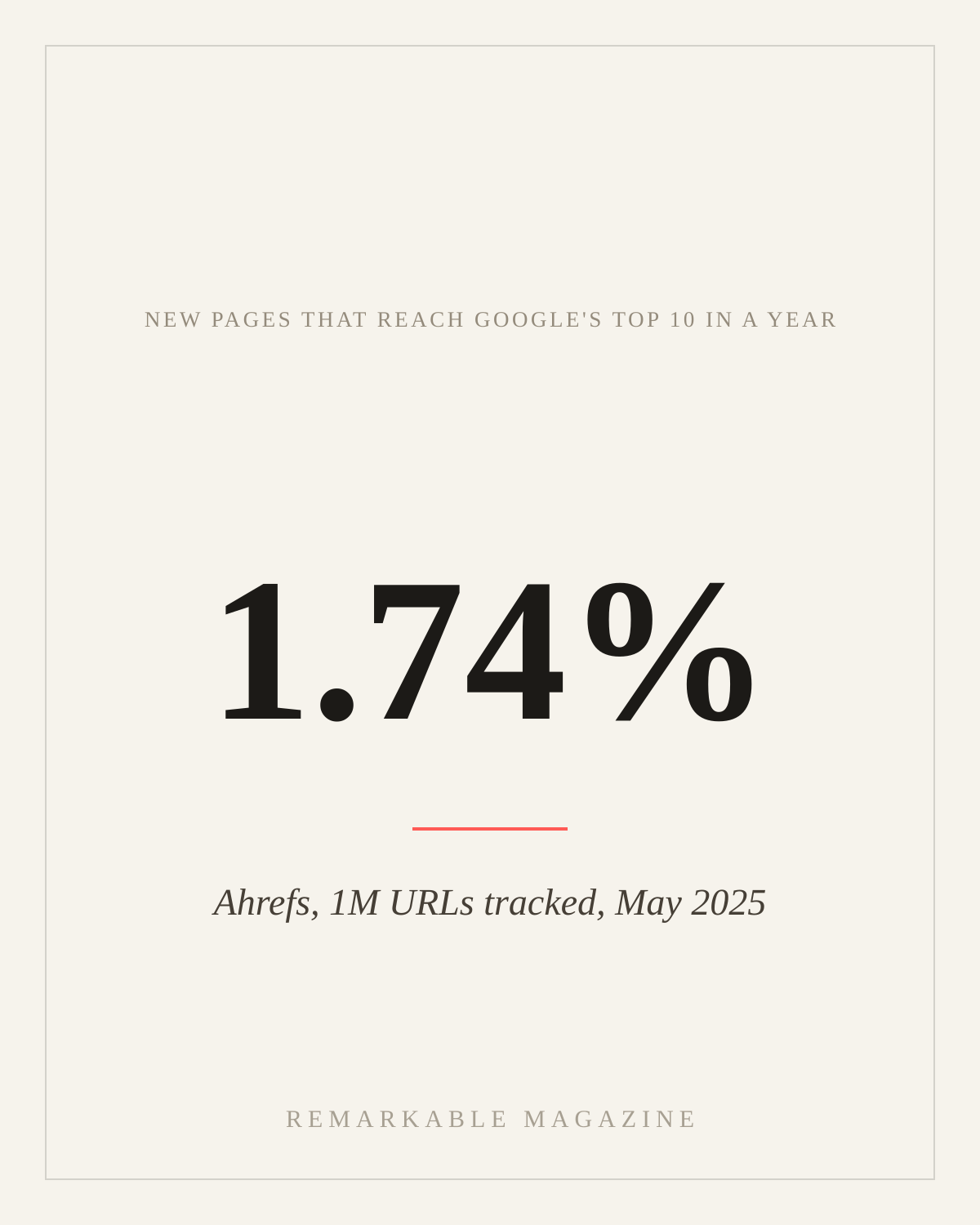
Ahrefs, the SEO tool company, tracked 1 million random URLs first indexed around September 2023 and checked how many reached Google’s top 10 for at least one keyword within their first year. The answer, published by Ahrefs’ Patrick Stox on May 15, 2025: 1.74% — down from 5.7% in a comparable study Ahrefs ran in 2017. Widen the filter to only non-empty English-language pages published in October 2023, and the number improves to 6.11%. Either way, the overwhelming majority of new pages simply never crack the top 10 in their first year.
Of the pages that did make it within a year, the timing was lopsided: 40.82% reached the top 10 within their very first month — almost always low-competition, low-volume terms with little to beat — while the rest arrived unevenly across the remaining eleven months. For genuinely high-volume, competitive keywords, Ahrefs found just 0.3% of pages broke into the top 10 within a year at all.
The study’s second finding explains why: Google’s top 10 is dominated by pages that have simply been around. 72.9% of current top-10 pages are more than three years old, up from 59% in the 2017 study. The average #1-ranking page is now about 5 years old, up from roughly 2 years in 2017. New content isn’t just competing on quality — it’s competing against incumbents with years of accumulated links, traffic signals and revisions.
A second study, a similar wall
Semrush ran a different kind of study over a different window and landed in the same place. Its researcher, Olga Andrienko, tracked 28,000 domains that had never appeared in Semrush’s US database before July 2021, following them for 13 months through July 2022.
Most didn’t survive as trackable competitors at all: only 2,155 domains (7.65%) held any ranking in Google’s top 100 for the full study period. Among that smaller, already-more-successful group, top-10 placement climbed and then leveled off around 41% by month six. Only 4.2% of the qualifying domains managed to hold at least one top-10 keyword ranking for all 13 months straight. By Semrush’s own bar for a genuine “winner” — at least 8 top-10 rankings and 1,160 or more in combined keyword search volume by month 13 — just 178 of the original 28,000 domains qualified. That’s roughly six in a thousand.
The study’s most actionable finding is about what separated the domains that made it from the ones that didn’t: backlinks. Among domains that reached the top 100, 92.3% had at least one referring domain. Among domains that failed to break into the top 10 at all, 55.1% had zero backlinks. Content depth mattered too — domains that ranked published pages averaging 846 words, against 243 words for the typical domain in the sample — and the domains that ranked best tended to target keyword phrases 3.2 to 3.5 words long rather than single broad terms.
What Google itself will tell you
For years, a specific line has circulated as Google’s official position: “in most cases, SEOs need four months to a year to help your business first implement improvements and then see potential benefit.” It traces to a Google spokesperson’s video years ago and still gets quoted as current guidance on agency blogs and in sales decks.
Fetched directly from developers.google.com for this piece, Google’s current Search Central SEO Starter Guide contains no such number. What it actually says is vaguer: “Some changes might take effect in a few hours, others could take several months.” It recommends waiting “a few weeks” before judging whether a change helped. Google, in other words, has backed away from giving a concrete timeline at all — which, given what Ahrefs and Semrush found, may be the more honest position.
What this doesn’t argue
It doesn’t argue that SEO doesn’t work, or that publishing is pointless. Both studies measured competitive, contested keywords across a broad, unfiltered sample of the internet — a low-competition local search or a genuinely novel long-tail phrase can rank far faster than either study’s averages suggest, and neither researcher broke results out by industry, location or business type. It also doesn’t argue that the 41% and 1.74% figures are the same claim: Semrush’s number describes domains that had already survived to hold some ranking; Ahrefs’ number describes the raw odds for any new page at all. And it doesn’t argue that older is automatically better — it argues that, empirically, most of what currently wins has had years to accumulate the links and signals a brand-new page hasn’t had time to earn yet.
How to actually plan around this
- Budget in quarters, not weeks. Both studies’ fastest real movement showed up around the two-to-six-month mark for pages that ranked at all — treat month one as invisible by design, not a sign something’s broken.
- Get at least one link before judging a page’s chances. Semrush’s 92.3%-versus-55.1% split on backlinks is the single sharpest signal either study produced. A page with zero external references is fighting a much steeper climb than the same page with one.
- Write longer, more specific pieces than the average competitor. The 846-versus-243-word gap and the 3.2–3.5-word keyword-length pattern both point the same way: depth and specificity, not breadth, is what separated Semrush’s winners.
- Expect the incumbents to still be there. With the average #1 page now roughly 5 years old, a new page’s realistic near-term goal is often displacing a weak page 3, not the entrenched #1.
- Don’t quote “four months to a year” as Google’s current position — it isn’t, on the page it’s usually attributed to. Use Google’s own present-tense guidance instead: some changes are fast, most aren’t, and a few weeks is the minimum before you can tell which kind you’re looking at.
Related reading
- How Much Should You Spend on Marketing? Two Answers — the budget question sitting one step upstream of this one.
- How To Hire Smarter And Get Millions Of Organic Visitors To Your Website — a founder’s own account of the publishing volume behind an organic-traffic outcome like the ones these studies measured.
- What Entrepreneurs Should Aim for in the Web Design of Their Sites — the site fundamentals question that has to be settled before any of this compounds.
The 1-million-URL sample, the 1.74%/5.7%/6.11% figures, the 40.82% within-first-month breakdown, the 0.3% high-volume-keyword figure, and the top-10 page-age figures (72.9%, up from 59%; average #1 page roughly 5 years old, up from roughly 2) are per Ahrefs, “How Long Does It Take to Rank in Google? And How Old Are Top Ranking Pages?” by Patrick Stox, published May 15, 2025, fetched directly from ahrefs.com. The 28,000-domain sample, the 7.65%/2,155-domain figure, the ~41% month-six top-10 rate, the 4.2% full-13-month figure, the 178-domain “winner” count and its 8-ranking/1,160-search-volume definition, the 92.3%/55.1% backlink split, and the 846-versus-243-word and 3.2–3.5-word-keyword findings are per Semrush, “Study: How Long Does It Take to Rank Higher on Google” by Olga Andrienko, published March 2, 2023, fetched directly from semrush.com. The current Google guidance quoted here is per Google’s Search Central SEO Starter Guide, fetched directly from developers.google.com during this research; the older “four months to a year” line is presented as a widely circulated but no-longer-documented claim, not verified against any current Google property.
Frequently asked
How long does SEO actually take to work?
Longer than most people are told. Ahrefs analyzed 1 million random URLs and found only 1.74% reached Google's top 10 within a year of publication (Patrick Stox, May 15, 2025). Semrush separately tracked 28,000 new domains for 13 months and found top-10 placement among the surviving group leveling off around 41% by month six, with only 178 of the original 28,000 domains meeting its bar for a ranking 'winner' by the end (Olga Andrienko, March 2, 2023). Both studies agree the realistic range for meaningful results is months, not weeks, and that a large share of new content never ranks competitively at all.
What actually determines how fast a page ranks?
Semrush's 28,000-domain study found backlinks were the clearest divider: 92.3% of domains that reached Google's top 100 had at least one referring domain, while 55.1% of domains with zero backlinks never reached the top 10. The same study found ranking domains published meaningfully longer content (846 words on average versus 243 for the typical domain in the sample) and tended to target keyword phrases 3.2 to 3.5 words long rather than single broad terms. Ahrefs' separate study found high-search-volume keywords are the hardest to break into quickly — only 0.3% of pages ranked in the top 10 for a high-volume keyword within a year — while most of the pages that did rank fast did so for lower-competition terms.
Does Google still say SEO takes four months to a year?
Not on its current documentation. A widely cited line — 'in most cases, SEOs need four months to a year to help your business first implement improvements and then see potential benefit' — has circulated for years as Google's official position, originally traced to a Google spokesperson's video on hiring an SEO. Fetched directly for this piece, Google's current Search Central SEO Starter Guide (developers.google.com) does not contain that wording. It says only that 'some changes might take effect in a few hours, others could take several months,' and recommends waiting a few weeks before assessing whether a change helped — guidance that is vaguer, not more specific, than the number still being quoted around the web.